
The ABM-Ready Demand Waterfall: How Account-Based Strategies Change Every Conversion Metric You Track


You've built the demand waterfall. Stages are defined, Salesforce is stamped, the conversion rates are running. Then the board approves an ABM motion, and suddenly the VP of Sales is asking a question your waterfall can't answer: "How are we tracking against the Tier 1 account list?"
The lead-level funnel your team spent months constructing doesn't break down by account.
It can tell you that 34% of MQLs converted to SALs last quarter. It can't tell you whether the six people from Acme Corp who engaged over the same period represent a buying group in active evaluation or six separate lead records floating in different pipeline stages.

This gap is exactly where most ABM programs stall. Companies launch account targeting, invest in intent data, run personalized campaign and then try to measure success with a funnel architecture built for individual leads. The metrics don't align. The board can't see account-level progress. Sales and marketing argue over whether an account is "in pipeline" or just "being worked." The solution isn't to abandon the demand waterfall. It's to evolve it. In this piece, we'll walk through
how the traditional demand waterfall changes when you shift to an account-based motion specifically, the differences in how stages are defined, how conversion rates are measured, and how buying group dynamics replace individual lead tracking as the primary signal of pipeline health.
If you're early in your demand waterfall journey and haven't yet built the foundation, the underlying methodology belongs in a different conversation. What we're addressing here is the evolution what changes about your waterfall architecture, your conversion tracking, and your analytics approach once accounts, not leads, become the primary unit of measurement.

Why the Traditional Demand Waterfall Breaks Under ABM
The traditional demand waterfall operates on a fundamental assumption: the unit of progression is a person. An individual submits a form. An individual is scored. An individual crosses the MQL threshold and gets routed to sales. Conversion rates measure the percentage of individuals who move from one stage to the next. This works well in a transactional, inbound-heavy model where individual decision-makers are both the entry point and the purchase authority. It breaks down when you're selling a $150K enterprise platform to a buying committee of seven people, none of whom submitted a form and all of whom need to reach alignment before any conversation can advance. Here's what the traditional waterfall misses in an ABM context:

Lead-level conversion rates hide account-level reality. You might see a healthy 28% MQL-to-SAL rate while your most strategic accounts stall at the inquiry stage because the contacts engaging are junior practitioners, not the economic buyers who need to be involved for a deal to close.
Duplicate leads create false pipeline signals. In enterprise buying scenarios, four people from the same account might be in four different funnel stages simultaneously. A lead-level waterfall reports this as four separate pipeline opportunities. An account-level view reveals it as one buying group in varied stages of engagement.
Velocity metrics become meaningless. Average days from MQL to SQL means nothing when "the deal" involves a VP of IT who's been dark for two months alongside an SDR relationship with a Director of Marketing Operations that's moved quickly. Account-level velocity tells you something. Lead-level velocity tells you very little in this context.
There is no signal for buying group completeness. In ABM, the question isn't just "has this contact progressed to the next stage?" It's "do we have coverage across the roles that need to be involved for a purchase decision?" The traditional waterfall has no architecture for this question.

The demand waterfall didn't fail. It was built for a different motion. ABM requires the same rigor defined stages, measurable thresholds, clear ownership applied to a different unit: the account, not the lead.
The Account-Based Waterfall: Stage Definitions That Actually Work
The ABM demand waterfall preserves the structural logic of the traditional model stages, entry and exit criteria, ownership, SLAs but redefines the unit of measurement and adds a layer of buying group intelligence on top. At marqeu, as part of our marketing analytics consulting practice, we've implemented account-based waterfall frameworks across dozens of B2B organizations shifting from a lead-centric to an account-centric motion. The stage architecture we've found most durable maps closely to the widely-adopted SiriusDecisions/Forrester Demand Unit Waterfall, adapted to each organization's sales model and CRM structure. The core stages in an account-based waterfall, and what distinguishes each from its lead-level counterpart:

Target Account (TA)
This is the entry point of the account-based funnel a named account that meets your ICP criteria and has been designated for active pursuit. In a traditional waterfall, there's no equivalent stage because the model is reactive (someone engages, they enter the funnel). In an ABM model, you define the target before engagement begins.
Entry criteria: Account meets firmo-graphic ICP (industry, headcount, tech stack, revenue band). Account has been approved and assigned as part of the go-to-market plan for the period.
What this changes analytically: Your conversion rate at the very top of the funnel is no longer "how many inquiries turned into MQLs?" It's "of all designated target accounts, what percentage showed first meaningful engagement?" This is a fundamentally different and more strategically useful question.

Active Demand Unit / Engaged Account
The account has demonstrated behavioral signals suggesting an active evaluation is underway. Crucially, these signals need to meet a minimum threshold of buying group coverage not just individual contact activity.
Entry criteria: Two or more contacts from the account have shown engagement in a defined window, AND at least one engagement has come from a persona matching the economic buyer or business stakeholder profile (not just a practitioner-level contact). Intent data signals above threshold can also qualify.
What this changes analytically: A single contact engaging from a target account does not qualify it for this stage. This is the first structural difference from a lead-level model, where a single MQL would trigger pipeline progression. Requiring multi-contact engagement catches the signal earlier and more accurately.
Marketing Qualified Account (MQA)
The account-level equivalent of the MQL, but with critical differences. An MQA isn't just an account that has enough scoring points it's an account where the pattern of engagement across multiple contacts suggests genuine buying intent from the people who matter.

Entry criteria: Account-level engagement score above threshold, spanning at least two to three key personas. Engagement depth (not just breadth) someone from the account has engaged with bottom-of-funnel content (pricing, ROI calculators, case studies, competitive comparisons). No hard suppression signals (competitor domain, existing customer, wrong segment).
What this changes analytically: Your MQA conversion rate from Engaged Account is typically lower than your MQL conversion rate from Inquiry in a traditional waterfall because the bar is higher. But the MQA-to-SAL rate is typically significantly higher, because you're advancing accounts that are actually ready for sales conversation, not just contacts who downloaded a white paper.
Sales Accepted Account (SAA) and Sales Qualified Account (SQA)
The sales handoff and qualification stages follow similar logic to their lead-level counterparts, but with two meaningful additions. First, acceptance isn't just a sales rep reviewing a single contact it's a rep or account executive confirming that there is a viable buying scenario at the account level. Second, the SAA-to-SQA progression requires documented discovery of organizational pain, budget context, and multi-stakeholder alignment.

What this changes analytically: Sales cycle velocity metrics at these stages become more meaningful because they reflect real enterprise buying dynamics. An account that progresses from SAA to SQA in 21 days is telling you something different than a lead that moves from SAL to SQL in 21 days in a transactional model.
Buying Group Dynamics: The Layer Your Waterfall Has Been Missing
The concept that most fundamentally separates ABM analytics from traditional demand waterfall analytics is the buying group. In enterprise B2B sales, purchase decisions are rarely made by one person. Research consistently shows that the typical enterprise buying committee involves six to ten stakeholders, each with different concerns, different information needs, and different levels of authority over the final decision.
A demand waterfall that doesn't model buying group dynamics can't tell you the thing you most need to know: not whether contacts are progressing, but whether the right contacts are progressing.
Defining the Buying Group for Your ICP
The first step is defining what a complete buying group looks like for your product. This varies by ICP, deal size, and sales model, but typically includes:
Economic Buyer: The person who controls the budget and makes or approves the final purchasing decision. Often a VP, SVP, or C-level depending on deal size.
Business Sponsor: The internal champion who owns the business problem you're solving. Often a Director or VP of Marketing, RevOps, or Sales depending on your product.
Technical Evaluator: The person who assesses technical fit and integration requirements. Often a marketing operations manager, data engineer, or IT stakeholder.
End User / Power User: The practitioner who will work with the product daily. Their objections or enthusiasm can significantly influence the decision even without formal authority.
Procurement / Legal (in enterprise): Often enters late but can stall or kill a deal if not engaged at the right time.

For marqeu's ICP Dir/VP/CMO at B2B technology companies with 10-500 employees, a complete buying group typically looks smaller than an enterprise deal: a marketing leader (economic buyer + sponsor), a marketing operations or revenue operations person (technical evaluator), and occasionally a CEO or CFO for larger engagements. Your buying group definition will look different. The critical step is documenting it.
Buying Group Coverage as a Funnel Metric
Once you've defined the buying group, you can track coverage the percentage of required roles that are actively engaged for each account. This is one of the most predictive metrics in ABM analytics, and one that has no equivalent in a lead-level waterfall. In our work implementing ABM analytics frameworks, we've found that accounts with 60% or higher buying group coverage at the MQA stage close at significantly higher rates than accounts where only one or two contacts have engaged, regardless of how high those individuals score individually.
Buying group coverage is a leading indicator of deal success that your lead-level conversion rates will never surface. A single highly-engaged contact at a target account is not a pipeline opportunity. Six engaged contacts representing four buying group roles is.
Practically, this means your CRM needs to track two things it probably doesn't currently track: (1) a persona or role field on contact records that maps to your buying group framework, and (2) an account-level coverage score that aggregates individual contact engagement across the required roles.
Engagement Gap Analysis
Once buying group coverage tracking is in place, engagement gap analysis becomes possible. For any account in active pursuit, you can identify which buying group roles are engaged and which are missing and use that gap to drive targeted outreach strategy.
A large networking infrastructure company working with us had a strong practitioner-level engagement pattern: technical evaluators were consistently engaging with their technical content, but economic buyers (VP-level and above) were almost never in the engagement data. Their MQA-to-SAA conversion rate was below 20%. After implementing buying group coverage tracking and building a content and outreach strategy specifically targeting VP-level personas at active accounts, MQA-to-SAA improved to 41% over two quarters. The conversion rate didn't change because of volume it changed because the accounts reaching the SAA stage were genuinely ready for sales engagement, not just technically curious.

Account-Level vs. Lead-Level Conversion Rates: What Changes and Why
The shift from lead-level to account-level conversion metrics is where most ABM analytics implementations get stuck. Teams either try to maintain both systems in parallel (which creates confusion), or they abandon lead-level metrics entirely (which loses visibility into contact-level behavior that still matters).
The right approach is a deliberate architecture that runs both tracking systems while clearly separating what each system is designed to answer.
The Metrics That Change
Several key conversion metrics look fundamentally different when measured at the account level versus the lead level:
Top-of-funnel volume: Lead-level volume tracks how many individuals entered the funnel. Account-level volume tracks how many unique target accounts entered the funnel. For a program focused on 500 named accounts, account-level volume is the more meaningful headline metric. You're trying to move accounts through stages, not maximize individual contact counts.
MQL/MQA conversion rate: Lead-level MQL rate measures what percentage of inquiries met individual scoring thresholds. Account-level MQA rate measures what percentage of engaged accounts demonstrated sufficient multi-persona engagement to justify sales involvement. These are different questions with different implications. A high MQL rate with low MQA rate tells you that individual contacts are engaging but buying group breadth is insufficient a content and persona coverage problem.

Sales acceptance rate: In a lead-level model, SAL rate measures how often sales accepts the leads marketing sends. In an account model, SAA rate measures how often sales confirms a viable buying scenario exists at the account. These acceptance conversations are substantively different one is a lead quality conversation, the other is a strategic account qualification conversation.
Velocity: Account-level velocity days from first engagement to qualified account to closed opportunity is often longer than lead-level velocity, because the multi-stakeholder alignment required in enterprise buying takes more time. But account-level velocity is more predictive of actual sales cycles because it reflects the real buying process, not just individual lead progression.

The Metrics That Stay the Same
Not everything changes in the shift to account-based measurement. Contact-level engagement data is still critical you need to know which individuals are engaging, with what content, at what frequency, to understand buying group dynamics. Lead scoring at the individual level still matters as an input into account-level MQA scoring. The underlying CRM data architecture (stage timestamps, lead source tracking, activity logging) is the same infrastructure that powers both models. Think of it as a layer architecture. Contact-level tracking is the foundation it captures all the individual signals. Account-level aggregation is the layer on top it synthesizes those signals into buying group intelligence and account-stage classification. Your reporting surfaces should surface account-level metrics for pipeline and board conversations, while your operational data remains at the contact level for campaign optimization and sales enablement.

Case Study: Rebuilding the Waterfall for an Account-Based Motion at a Mid-Market Security Platform
A mid-market cybersecurity SaaS company had been running a traditional demand waterfall for 18 months. Their lead-level metrics looked reasonable: 31% MQL-to-SAL rate, 22% SAL-to-SQL rate. But their close rate from SQL was under 12%, and the sales team reported that most of the pipeline they were working felt "not quite ready." The deals that did close took an average of 6 months from first contact.
The root issue: their demand waterfall was built for individual leads, but their product required sign-off from both a CISO-level sponsor and a VP of IT on the technical side. Deals were reaching SQL status based on strong practitioner engagement while neither decision-maker had been meaningfully involved.
marqeu rebuilt their waterfall around accounts. We defined a four-role buying group specific to their ICP (CISO or VP Security as economic buyer; IT Director as technical evaluator; SOC lead or SecOps Manager as end user; procurement for deals above a defined threshold). We built account-level scoring in HubSpot that aggregated individual contact scores by role, and set MQA criteria that required both economic buyer and technical evaluator engagement above minimum thresholds.
Results over 2 months:
MQA volume dropped by 38% but MQA-to-SAA conversion increased from 24% to 58%.
SQL-to-Close rate improved from 12% to 29%.
Average sales cycle from MQA to close shrank from 6.2 months to 4.1 months.
The waterfall was producing fewer, better opportunities which was exactly the signal the business needed to calibrate sales capacity planning and marketing investment.

Configuring Your CRM and MAP for Account-Based Waterfall Tracking
The account-based demand waterfall is not just a conceptual shift it requires deliberate CRM and marketing automation configuration.
Lead-level systems need to be extended with account-level objects, scoring models, and stage logic before any of the analytics described above become reportable.
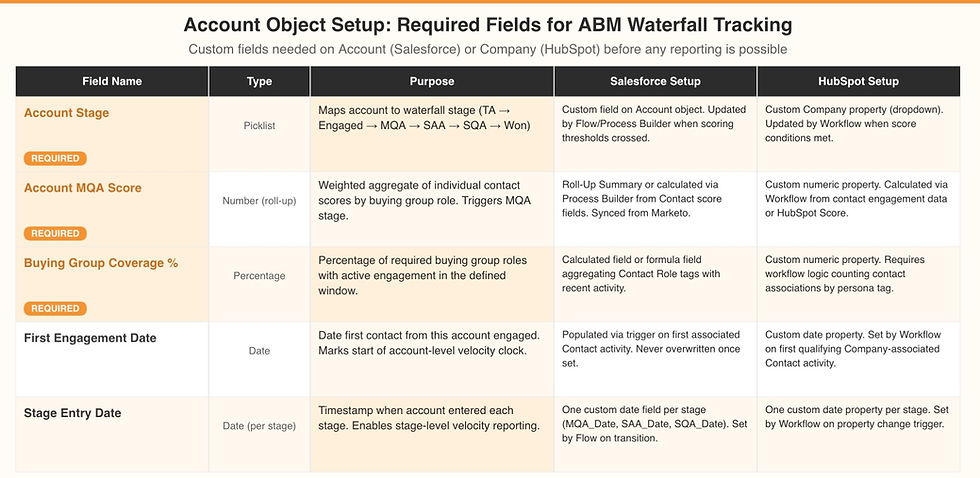
Account Object Setup
In Salesforce, the Account object needs several custom fields to support ABM waterfall tracking:
an Account Stage field (mapped to your waterfall stages),
an Account MQA Score field (a calculated or regularly-updated roll-up from contact scores),
a Buying Group Coverage field (percentage of required roles with active engagement),
a First Engagement Date at account level,
a Stage Entry Date for each stage transition.
In HubSpot, this configuration lives on the Company record. Company properties need to mirror the same fields. The challenge in HubSpot is that its native scoring and lifecycle stage tools are contact-centric, so custom properties and workflows are typically required to calculate account-level scores from contact activity.

Contact Persona Mapping
Every contact in your CRM should have a Buying Group Role field that maps to your defined buying group framework. This field enables the coverage calculation that makes account-level MQA scoring possible. The challenge is keeping this field populated accurately which requires a combination of explicit data capture (asking during form fills or discovery calls), predictive modeling from title and seniority data, and sales rep input during account research.
In Salesforce + Marketo environments, we typically build a field mapping rule that auto-populates a default role from job title parsing, with a manual override available for sales. This approach achieves 70-80% accuracy without requiring manual data entry for every contact.

Account-Level Scoring Logic
Account MQA scoring aggregates individual contact scores with weighting by buying group role. The formula we use most commonly: Economic Buyer engagement score × 2 (highest weight), Business Sponsor score × 1.5, Technical Evaluator score × 1, End User score × 0.75. An account qualifies as MQA when the weighted aggregate score exceeds the threshold AND at least one contact from the Economic Buyer or Business Sponsor role is above a minimum individual score.
This prevents a scenario where six highly-engaged practitioners generate a high account score without any decision-maker engagement a common failure mode in ABM implementations that haven't added role-weighting to their scoring models.

Stage Transition Automation
Account stage transitions should be automated where possible based on the entry criteria you've defined, with manual sales rep confirmation required at the SAA stage. In Salesforce, this typically means a Process Builder or Flow that evaluates account MQA score and buying group coverage daily and updates the Account Stage field when thresholds are crossed. A notification or task is created for the assigned AE to confirm SAA acceptance the human check-in that prevents fully automated pipeline inflation.
The Analytics Layer: What to Report on and How
With the infrastructure in place, the account-based waterfall unlocks a reporting layer that is qualitatively different from what a lead-level model can produce. Specifically, it enables the four categories of account-based analytics that we consider core to any mature ABM program:

Account Funnel Health
A real-time view of how target accounts are distributed across waterfall stages, with conversion rates at each transition. This replaces the lead-level funnel snapshot as the primary dashboard metric for ABM-focused marketing and sales teams. Key metrics: accounts by stage, stage-to-stage conversion rates, accounts advancing week-over-week, accounts stalling at each stage.
Buying Group Coverage Reporting
For any cohort of accounts (by tier, vertical, sales territory, or campaign), what is the average buying group coverage score? What percentage of accounts in the active stage have coverage across all required roles? Where are the gaps which roles are consistently missing? This reporting directly informs content strategy and sales outreach prioritization.

Account Velocity Analysis
How long are accounts spending at each stage? Where are accounts stalling? Which account attributes (tier, vertical, deal size, buying group completeness) correlate with faster progression? Velocity analysis at the account level surfaces the same types of insights as velocity analysis in a lead-level waterfall, but with the added dimension of buying group dynamics as an explanatory variable.

Pipeline Influence and Attribution at the Account Level
Traditional campaign attribution measures which campaigns influenced which leads. ABM attribution measures which campaigns and account-based interactions influenced which accounts and specifically, which interactions reached which buying group roles. This is a more complex analytics challenge, but it produces significantly more actionable insights: you can see not just that a campaign influenced pipeline, but whether it moved economic buyers or only practitioners, and whether it contributed to buying group coverage gaps or completeness. This level of attribution requires the persona mapping and account-level tracking infrastructure described above which is why the analytics capability and the CRM configuration are deeply interdependent. You can't report on buying group attribution without first tagging contacts by role and tracking account-level stage progression.
Case Study: Account-Level Attribution Reveals a Critical Content Gap at a B2B Data Platform
A B2B data platform company had invested heavily in ABM for two years and was seeing healthy account engagement rates at the target account level. But pipeline from their Tier 1 account list (50 strategic accounts) was underperforming relative to investment. The question they couldn't answer: why were accounts engaging but not converting to SAA?
After implementing buying group role tagging and account-level attribution, the answer became visible. Their content library was producing strong engagement from data engineers and analytics practitioners (technical evaluators and end users), but almost no content was connecting with the VP of Data or CDO-level economic buyers at these accounts. Buying group coverage scores confirmed this: average coverage at the MQA stage was 38%, almost entirely practitioner-level.

marqeu built an account-level attribution report segmented by buying group role and identified that economic buyer engagement events were 4x more predictive of SAA conversion than practitioner engagement events at the same volume. The team redirected 30% of content budget toward executive-level thought leadership specifically addressing CDO-level priorities. Within one quarter, economic buyer engagement at Tier 1 accounts increased by 65%, average buying group coverage at MQA improved to 61%, and SAA conversion from MQA increased from 19% to 44%.
Connecting the Demand Waterfall to Your ABM Content Strategy
The account-based demand waterfall doesn't just change your analytics it changes how you think about content and campaign strategy.
In a lead-level model, content is mapped to funnel stages: top-of-funnel awareness content, mid-funnel evaluation content, bottom-of-funnel decision content. In an account-based model, content needs to be mapped to two dimensions simultaneously: funnel stage AND buying group role.
This creates a matrix: on one axis, where is the account in the waterfall? On the other axis, which buying group role are we trying to reach? The intersection defines what content is needed. An economic buyer at an account in the Engaged Account stage needs something very different from a technical evaluator at the same account in the same stage. And both need something different from any contact at an account you haven't yet engaged.
In our experience implementing this content matrix across ABM programs, the most common gap is in the upper-right quadrant: content for economic buyers at late-stage (MQA and beyond) accounts. Practitioners are well-served by most B2B content libraries. Economic buyers who consume less content but whose engagement is more predictive of deal progression are frequently underserved. Filling this gap is often the single highest-leverage content investment for an ABM program that has buying group tracking in place.
Stage-Specific Content Mapping
For each stage in your account-based waterfall, define the content and interactions most effective at driving progression to the next stage, segmented by buying group role:

Target Account → Engaged: Awareness-driving content that reaches all buying group roles. For economic buyers, this means thought leadership tied to business outcomes. For technical evaluators, it means practical guides on methodology and implementation. For practitioners, it means tactical how-to content.
Engaged → MQA: Evaluation-stage content that surfaces for accounts with some engagement but incomplete buying group coverage. Targeted campaigns designed to reach the missing roles at partially-engaged accounts.
MQA → SAA: Decision-support content for economic buyers specifically ROI frameworks, peer case studies, board-ready metrics narratives. This is the content that gives economic buyers what they need to justify internal prioritization.
SAA → SQA: Sales-enablement content for the discovery and qualification process competitive battle cards, technical architecture guides for evaluators, implementation planning materials.
Governance and the Account-Based Waterfall: What the Monthly Review Changes
The governance principles of the demand waterfall monthly reviews, defined escalation paths, stage criteria maintenance apply equally in an account-based model. But the content of those reviews changes significantly.
In a lead-level waterfall governance review, the primary questions are: Are conversion rates at each stage on trend? Are velocity metrics within acceptable ranges? Are there data quality issues (leads without scores, missing timestamps)?

In an account-based waterfall review, those questions are still relevant but are joined by account-specific questions: Which target accounts are stalling and why? What is the buying group coverage distribution across stages? Are there accounts where sales has engaged but buying group coverage is insufficient a signal of premature handoff? Are there accounts with high coverage scores that haven't been accepted by sales a signal of acceptance criteria drift?
The monthly governance review for an ABM waterfall is also where account-tier review happens. ABM programs typically segment target accounts into tiers (Tier 1 for most strategic, Tier 2 for high-potential, Tier 3 for broader net). Stage progression patterns and buying group coverage tend to differ by tier. Your governance review should surface these differences if Tier 1 accounts are showing lower coverage than Tier 2, that's a signal worth investigating.
Frequently Asked Questions
What is the difference between an MQL and an MQA?
An MQL (Marketing Qualified Lead) is an individual contact who has met a scoring threshold based on their own behavior and profile. An MQA (Marketing Qualified Account) is an entire company account that has demonstrated sufficient multi-persona engagement, including from key buying group roles, to justify sales involvement. An MQA requires evidence of buying intent across the account, not just from a single contact.
Do I need to abandon lead-level tracking to implement ABM analytics?
No. Contact-level tracking remains essential it provides the individual signal data that account-level scoring aggregates. The shift is in what you report and optimize at the top level. Account-level metrics drive pipeline conversations and board reporting. Contact-level data drives campaign optimization and sales outreach targeting. Both run simultaneously in a mature ABM analytics architecture.
What is buying group coverage and how do you measure it?
Buying group coverage measures what percentage of your defined buying committee roles have active engagement at a given account. If your buying group requires four roles and two are actively engaged, coverage is 50%. It is measured by tagging contacts with their buying group role in your CRM, then calculating an account-level ratio of engaged roles to required roles within a defined engagement window.
How should conversion rate benchmarks change for an account-based waterfall?
Account-based conversion rates are typically lower at the top of the funnel (fewer accounts qualify as MQAs than individuals qualify as MQLs) but higher at the bottom (accounts that reach late stages are more purchase-ready). MQA-to-SAA rates of 40-60% are achievable in well-configured ABM programs, versus MQL-to-SAL rates that often run 20-35% in lead-level models. See our benchmarks guide for detailed industry comparisons.
Can an ABM waterfall work in HubSpot or is it Salesforce-only?
Both platforms support account-based waterfall tracking, though the configuration approach differs. Salesforce's Account object natively supports the custom fields and workflows needed for stage tracking. HubSpot requires custom Company properties and more complex workflow logic to achieve the same result. For organizations with HubSpot + a strong RevOps resource, full ABM waterfall implementation is achievable but requires more custom build work.
Building the Analytics Foundation for Your ABM Motion
The shift to account-based measurement isn't just a reporting change it's a fundamental rearchitecting of how you define pipeline health, measure marketing effectiveness, and connect marketing activity to revenue outcomes.
For organizations that have already invested in ABM strategy and account targeting, the analytics infrastructure described here is what turns that investment from an act of faith into a measurable program.
At marqeu, we've built and rebuilt account-based demand waterfall frameworks across B2B technology companies at every stage of ABM maturity from organizations running their first named account list to teams optimizing multi-tier programs that have been running for years. The work spans CRM configuration, scoring model design, buying group taxonomy, reporting architecture, and the governance systems that keep it all calibrated over time.
If your organization is preparing for an ABM motion or is already running one but can't get clear visibility into account-level pipeline health, the place to start is the analytics foundation. The accounts, the targeting, and the campaigns are only as valuable as your ability to measure their impact with precision.

But implementation matters as much as intent. A poorly defined waterfall is worse than no waterfall it creates the illusion of measurement without the substance:
The stage definitions need to be precise.
The tech stack needs to capture the right data at the right transitions.
The reporting needs to go beyond snapshots into cohort analysis and velocity tracking.
The governance needs to keep the whole system calibrated as your business evolves.
When you're ready to build that foundation, marqeu's marketing analytics consulting practice works directly with marketing and revenue operations teams to implement the full analytics stack from waterfall configuration to buying group tracking to board-ready reporting. The path to account-level visibility is clearer than it looks when you have the right architecture in place.
If your organization is ready to implement a demand waterfall or if you’ve already started and the results aren’t matching expectations marqeu’s marketing analytics consulting team can help. We’ve deployed this methodology across numerous B2B organizations and know where the implementation traps are before you hit them. The first conversation is about understanding your current state your tech stack, your data maturity, and where the gaps are. From there, we build the roadmap.
Book a Marketing Analytics Readiness Audit. With our marketing analytics consulting services, let us evaluate your current stack and give you a roadmap to building unified marketing analytics capabilities at your organization.


Comments