
Lead Flow Management

For B2B marketing organizations, lead flow management is the connective tissue between demand generation investment and revenue outcomes. It is not enough to generate leads.
The speed at which those leads are routed, the accuracy with which they are scored, and the precision with which they are handed from marketing to sales determine whether your pipeline grows or stalls.
At marqeu, we have spent over a decade helping 85+ B2B organizations design leverage our B2B marketing analytics expertise, implement, and continuously optimize lead flow management frameworks that turn marketing activity into predictable revenue. This page covers everything B2B marketing operations and revenue operations leaders need to know about
building a high-performance lead management system: from defining your demand funnel stages and lead lifecycle to implementing lead routing automation, optimizing MQL to SQL conversion rates, accelerating speed to lead, and measuring the RevOps lead management metrics that actually matter.

What Is B2B Lead Flow Management and Why Does It Define Your Pipeline?
Lead flow management is the end-to-end system that governs how a lead enters your marketing database, moves through your demand funnel, and ultimately reaches the right sales representative at the right moment.
It spans lead capture, data enrichment, behavioral scoring, qualification thresholds, routing logic, sales handoff, and closed-loop reporting.
When this system functions well, marketing and sales operate in lockstep. When it breaks down, leads fall through cracks, sales teams distrust the MQL queue, and marketing spend generates activity without generating revenue.
The challenge for most B2B organizations is that lead flow management is not a single technology problem. It sits at the intersection of your CRM configuration, your marketing automation platform, your lead scoring model, your sales territory design, and your pipeline reporting architecture. A change in one area cascades through all the others. New sales territories require updated routing rules. A new marketing channel requires new lead source tracking. A product pivot requires recalibrating the ICP signals in your scoring model. Organizations that treat lead flow management as a set-and-forget implementation almost always find themselves six to twelve months later with a system that no longer reflects how the business actually goes to market.
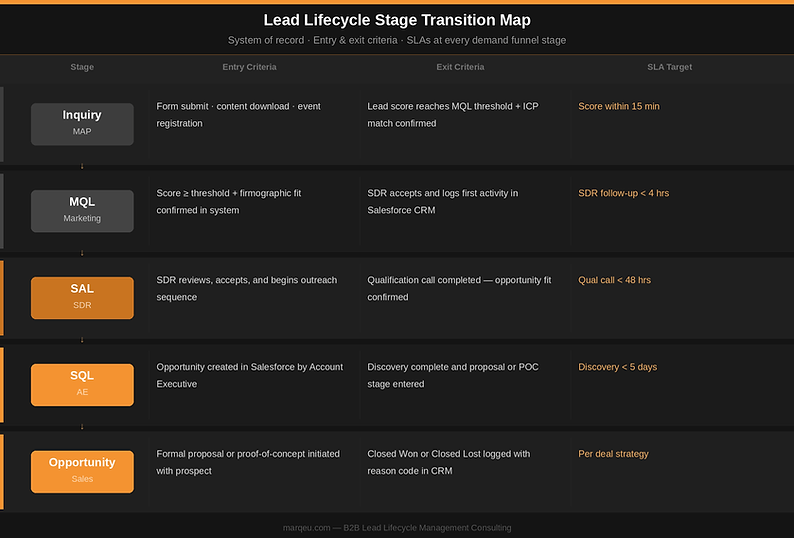
At marqeu, we define a mature B2B lead management framework as one that operates across six interconnected dimensions: funnel architecture, lead scoring, lead routing automation, SLA and speed-to-lead governance, MQL to SQL conversion optimization, and closed-loop performance measurement. Each dimension reinforces the others.
Together, these 6 dimensions create the operating infrastructure that allows a B2B marketing organization to generate pipeline with confidence and efficiency.
The B2B Lead Management Framework: 6 Dimensions of a High-Performance System
Most organizations implement pieces of a lead management system without ever connecting them into a coherent framework. The result is a patchwork of workflows that function in isolation but fail as a system. marqeu's B2B lead management framework addresses all six dimensions in sequence, with each layer of work building on the one before it.
1. Demand Funnel Architecture and Lead Lifecycle Definition
Before a single routing rule is written or a scoring model is calibrated, your organization needs a shared, documented definition of what your demand funnel looks like and what constitutes a lead at each stage. This sounds foundational because it is. In the hundreds of marketing and sales conversations our team has facilitated, the single most common source of lead management dysfunction is the absence of agreed funnel stage definitions between marketing and sales.

At marqeu, we work with your marketing, SDR, and sales leadership to map your unique demand funnel:
-
From raw Inquiry through Marketing Qualified Lead, Sales Accepted Lead, Sales Qualified Lead, and Opportunity.
-
We define the entry and exit criteria for each stage, the systems that own each transition
-
We define the SLAs that govern how quickly leads must be acted upon at each handoff.
-
We map the parallel contact-level and account-level journey for organizations running account-based marketing motions, ensuring your lead management framework works for both inbound and outbound pipelines.
The output is a documented demand funnel model that becomes the blueprint for everything that follows: the scoring model, the routing rules, the nurture architecture, and the reporting framework. Without this foundation, lead management improvements address symptoms rather than the underlying system design.
2. Contextual Lead Scoring Aligned to Your ICP and Buying Signals
Lead scoring is the engine that drives qualification decisions across your entire demand funnel. A well-designed scoring model surfaces the leads that are genuinely ready for sales engagement and suppresses the noise of high-volume, low-quality interactions. A poorly designed model does the opposite: it floods the MQL queue with contacts that sales ignores, eroding trust between marketing and sales and eventually causing the MQL threshold to be raised so high that real opportunities are missed.

marqeu's approach to lead scoring draws on our deep expertise in marketing analytics to build what we call a contextual scoring model.
This model integrates 3 dimensions:
-
Demographic and firmographic fit (does this contact match your Ideal Customer Profile in terms of company size, industry, title, and technology stack?)
-
Behavioral engagement (what actions has this contact taken that signal genuine purchase interest, and how recent and frequent are those signals?)
-
Intent data (are there third-party buying signals that indicate this contact or their account is actively researching a solution in your category?).
We build scoring models in Marketo, HubSpot, and Salesforce with proper decay rules that reduce the weight of older interactions over time, velocity weightings that boost the score of contacts who demonstrate accelerating engagement, and negative scoring adjustments that penalize actions that indicate poor fit. We also design the feedback loop that keeps your scoring model current as your ICP evolves and as your sales team shares conversion data on which lead attributes correlate with closed-won deals. The result is a scoring model that your sales team actually trusts and acts on because it reflects the real buying signals that predict conversion.
3. Lead Routing Automation: The Architecture of Speed and Precision
Lead routing automation is one of the highest-impact and most frequently underbuilt components of a B2B lead management system. When a lead reaches MQL status, every minute that passes before it reaches the right sales representative is a minute of buying momentum lost. Research consistently shows that speed to lead is one of the strongest predictors of lead conversion: responding within the first five minutes of a lead expressing intent is dramatically more effective than responding within an hour, and exponentially more effective than the multi-day response times that are common at organizations without automated routing.
At marqeu, we design and implement lead routing automation architectures that route every qualified lead to the right sales owner instantly and accurately, regardless of how complex your sales territory model is. Our routing frameworks handle the full range of routing scenarios that B2B organizations encounter:

-
Territory-based routing that assigns leads to the correct account executive or SDR based on geography, vertical, or named account ownership
-
Account-based routing that matches inbound leads to existing CRM accounts and routes them directly to the account owner, bypassing round-robin queues
-
Round-robin routing for new accounts with fair distribution logic and overflow handling when reps are at capacity or out of office
-
Score-based routing that directs the highest-scoring leads to the most experienced or highest-performing reps, maximizing conversion probability on your best opportunities
-
Product-based and segment-based routing for organizations with multiple product lines or distinct customer segments requiring specialist sales coverage
-
SDR to AE handoff automation that eliminates the friction and delay of manual transfers once an SDR has qualified a lead for account executive engagement
We implement routing logic in Marketo, HubSpot, Salesforce, and specialized routing tools such as LeanData, Clay, ZoomInfo depending on your existing stack. All routing rules are documented, version-controlled, and built with the business change scenarios in mind, so that when new territories are added or a reorganization occurs, your routing framework can be updated cleanly without breaking existing flows.
4. Speed to Lead: SLA Governance and Follow-Up Automation
Speed to lead is the interval between a lead reaching MQL status and the first meaningful follow-up from a sales representative. It is one of the most important and most under-tracked metrics in B2B marketing operations. Organizations that respond to qualified leads within five minutes convert at dramatically higher rates than those that respond within an hour, and organizations that respond within an hour convert at a fraction of the rate of those that take 24 hours or longer.

The challenge is that speed to lead is not primarily a motivation or training problem. It is a systems problem. When routing rules misfire, when Salesforce assignment rules have exceptions that create unassigned lead queues, when the SDR notification system fails silently, or when handoff SLAs are undefined, leads sit untouched not because sales does not care but because the system failed before the lead ever reached a human. marqeu's lead management consulting addresses speed to lead as a systems design challenge: we build the routing automation, the follow-up notification infrastructure, the SLA monitoring dashboards, and the escalation workflows that ensure every qualified lead receives timely follow-up regardless of which channel it came from, which time zone the rep is in, or what is happening in the sales organization on any given day.
For B2B organizations with outbound SDR teams, we build the automated workflows that alert reps the moment a high-intent lead takes a qualifying action, trigger personalized follow-up sequences based on the specific content or channel that drove the conversion, and escalate to a manager if an SLA breach threshold is approaching. We also build the operational dashboards that make SLA compliance visible to marketing and sales leadership so that response time performance is tracked as rigorously as MQL volume.
5. MQL to SQL Conversion: Optimizing the Marketing-to-Sales Handoff
MQL to SQL conversion rate is the most important measurement of lead management quality. It tells you whether the leads your marketing programs are generating are leads that sales can actually work. Low MQL to SQL conversion rates are almost always a symptom of one of three structural problems: a scoring model that overestimates purchase intent, a handoff process that loses context between marketing and sales, or a misalignment between what marketing defines as an MQL and what sales defines as a workable opportunity.

marqeu's MQL to SQL conversion optimization process begins with a detailed analysis of your current conversion rates across funnel stages, lead sources, scoring segments, and time periods. We use your Salesforce and Marketo data to identify the specific lead attributes, behavioral signals, and campaign sources that are most and least predictive of SQL conversion. We then use those insights to recalibrate your scoring model, redefine your MQL threshold, and redesign the handoff workflow to ensure that the context marketing has accumulated about a lead's journey is fully transferred to the sales rep at the moment of assignment.
In our experience across 85+ B2B implementations, improving MQL to SQL conversion by 10 to 20 percentage points is achievable within a single quarter when the scoring model and handoff process are properly redesigned. The downstream impact is significant: more pipeline from the same demand generation spend, higher sales productivity because reps are working better leads, and a restored trust relationship between marketing and sales that unlocks closer collaboration on campaign strategy and ICP targeting.
6. RevOps Lead Management Reporting and Closed-Loop Analytics
A lead management framework without rigorous measurement is a system that cannot improve. The reporting layer of a mature RevOps lead management infrastructure tracks not just volume metrics like MQL count, but the conversion rates, velocity, and SLA performance across every stage of the funnel. It answers the questions that CMOs, VPs of Marketing, and CROs need answered to make investment decisions:
-
Which channels are producing leads that convert?
-
Where are leads stalling in the funnel?
-
What is the average time from MQL to Opportunity, and is it trending in the right direction?
-
Which scoring segments are over-producing junk leads that sales is rejecting?
At marqeu, we build closed-loop lead management reporting frameworks that connect marketing activity data in Marketo or HubSpot with pipeline and revenue data in Salesforce. For organizations that need deeper analytics, we implement data warehouse architectures using Snowflake or BigQuery with automated ETL pipelines powered by Fivetran or Census that feed Tableau, Looker, or Sigma dashboards. These dashboards give marketing and sales leadership a single source of truth for funnel performance that is updated in near real-time, enabling weekly optimization cycles rather than the quarterly reviews that most organizations are limited to today.
The specific metrics our RevOps lead management dashboards track include: lead-to-MQL conversion by source and campaign, MQL to SQL conversion rate and trend, SQL to Opportunity conversion, average funnel velocity by stage, SLA compliance rate by territory and lead type, lead routing accuracy, and marketing's contribution to pipeline and closed-won revenue. These are the operational metrics that transform a marketing operations team from a cost center into a revenue driver.

Lead Management: Aligning Marketing, SDRs, and Sales Across the Full Funnel
Revenue operations has emerged as the dominant organizational framework for aligning marketing, sales, and customer success around shared data, shared processes, and shared revenue goals. Within a RevOps model, lead management is not a marketing function or a sales function. It is a cross-functional system that must be designed, owned, and optimized at the RevOps level to function effectively.
The most common RevOps lead management failure mode we see is organizational, not technical. Marketing defines an MQL as any contact who scores above a threshold. Sales defines a workable lead as one that matches the ICP, has shown explicit buying intent, and has a contact at the right seniority level. These definitions are never reconciled in a shared document, never enforced in the CRM, and never measured through shared metrics. The result is a persistent marketing-to-sales alignment gap that no amount of campaign optimization can close.

marqeu's RevOps lead management practice bridges this gap by facilitating the joint design of lead definitions, handoff criteria, and SLAs between marketing, SDR, inside sales, and field sales leadership. We document these agreements in a Lead Management Charter that becomes the operating contract between teams, encoded into the CRM and marketing automation platform so that the system enforces the agreements rather than relying on human coordination. For organizations with a RevOps function, we work as a strategic implementation partner to translate RevOps strategy into the technical configurations that make the strategy real.
We have found consistently that B2B organizations that treat lead management as a RevOps discipline rather than a marketing operations task achieve significantly higher MQL to SQL conversion rates, faster funnel velocity, and stronger marketing-attributed pipeline. The difference is not just technical. It is structural: when everyone from the CMO to the SDR manager has agreed on what a good lead looks like and how it should be handled, the entire system performs at a higher level.
Client Results: What B2B Organizations Achieve with marqeu's Lead Management Consulting
The strongest measure of a lead management consulting practice is the operational results it delivers for clients. Here are three representative engagements from our portfolio.
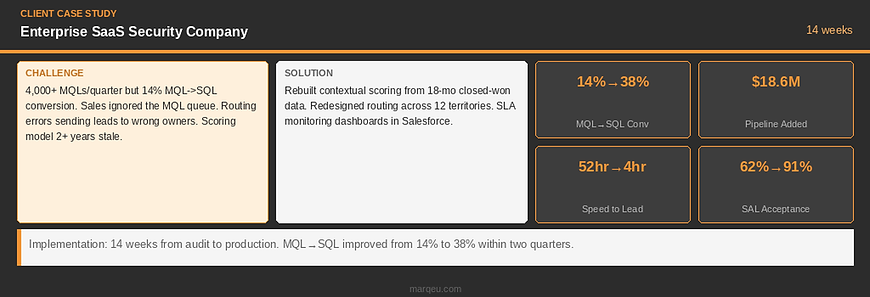
Enterprise SaaS Security Company
CHALLENGE: This organization was generating over 4,000 MQLs per quarter but experiencing a 14% MQL to SQL conversion rate. Sales leadership had lost confidence in the MQL queue and was largely ignoring it, relying instead on outbound prospecting. The Marketo-Salesforce integration had multiple routing rule gaps that were sending leads to the wrong owners, and the scoring model had not been updated in over two years despite three product launches and a significant ICP shift.
SOLUTION: marqeu conducted a comprehensive lead management audit, rebuilt the contextual scoring model from scratch using 18 months of closed-won and closed-lost data to identify the behavioral and firmographic signals that actually predicted conversion, redesigned the routing architecture across 12 sales territories, and implemented SLA monitoring dashboards in Salesforce that tracked response time compliance by rep and manager.
RESULTS:
-
MQL to SQL conversion rate improved from 14% to 38% within two quarters.
-
Pipeline generated from marketing-sourced MQLs increased by $18.6M year over year.
-
Average speed to lead improved from 52 hours to under 4 hours.
-
Sales acceptance of marketing MQLs climbed from 62% to 91%, effectively restoring the trust relationship between marketing and sales.
-
Implementation timeline was 14 weeks from audit to production.

B2B Financial Technology Company
CHALLENGE: Rapid growth had outpaced the organization's lead management infrastructure. The company was expanding from SMB into mid-market and enterprise segments simultaneously, which required fundamentally different routing logic, scoring weights, and handoff processes. The existing lead management framework was a single-track model designed for SMB volume, and it was not equipped to handle the account complexity of enterprise deals or the longer nurture cycles of mid-market prospects.
SOLUTION: marqeu designed a multi-segment lead management framework in HubSpot and Salesforce with separate scoring models for each segment, segment-specific MQL thresholds, and routing rules that directed SMB leads to a high-velocity SDR team while routing enterprise leads to a dedicated enterprise sales team for high-touch engagement. We also implemented a lead management analytics dashboard in Tableau connected to a Snowflake data warehouse, providing real-time funnel performance visibility across all three segments.
RESULTS:
-
Enterprise pipeline from inbound leads increased 240% within two quarters of go-live.
-
Overall MQL to SQL conversion improved from 19% to 44%.
-
Funnel stage velocity improved across all segments with mid-market leads moving from first touch to opportunity 31% faster.
-
The Tableau dashboard reduced the time MOps spent on manual reporting from 12 hours per week to under 2 hours.

Enterprise HR Technology Company
CHALLENGE: This mature organization had an established lead management process that had not been fundamentally reviewed in three years. New CRM territories, five new products, and a regional expansion into EMEA had layered complexity onto an aging framework that was producing routing errors on roughly 22% of all MQLs. Marketing was spending 15 hours per week manually correcting misrouted leads, and the SLA breach rate had climbed to 41% with no monitoring system in place to catch it.
SOLUTION: marqeu conducted a full lead management framework audit across Marketo and Salesforce, documenting every routing rule, scoring trigger, and lifecycle transition. We rebuilt the routing architecture to handle the current territory model cleanly, implemented automated SLA monitoring with escalation alerts in Slack and Salesforce, redesigned the EMEA lead flow model to account for GDPR compliance requirements, and built a lead management performance dashboard that gave marketing and sales operations leadership daily visibility into funnel health.
RESULTS:
-
Routing error rate reduced from 22% to under 1% within 60 days.
-
SLA compliance climbed from 59% to 94%.
-
Manual lead correction effort was eliminated, recovering 15 hours per week of MOps capacity.
-
EMEA lead flow was fully GDPR-compliant at launch. The engagement took 11 weeks from audit to final deployment.
Leveraging Marketing Analytics to Drive Lead Scoring Performance
The key theme that separates marqeu's lead management consulting from conventional marketing operations consulting is our depth in marketing analytics. Most lead management engagements treat scoring and routing as configuration tasks: set the thresholds, write the rules, go live.
We treat them as analytical problems that require a data-driven approach to get right and a continuous measurement framework to keep right.
Before we design a scoring model, we analyze your historical closed-won and closed-lost data to understand which lead attributes, behavioral signals, and campaign interactions are statistically predictive of conversion.

We use Python-based analysis and, for clients with a Snowflake or BigQuery data warehouse, we run this analysis directly against the full population of historical leads rather than relying on the limited sample that native Marketo or HubSpot reporting surfaces. This analytical foundation means the scoring model we build is grounded in evidence, not assumption. Beyond initial model design, we build the measurement infrastructure that allows the scoring model to improve over time. We connect lead score data with Salesforce opportunity outcomes using Fivetran or Census pipelines that keep the data fresh, and we build Tableau or Looker dashboards that surface the scoring model's performance metrics weekly. When the model shows signs of drift, typically a symptom of ICP evolution or new product introductions, our team recalibrates the model against the most recent conversion data without requiring a full re-implementation.
This analytics-driven approach to lead scoring is what allows marqeu's clients to achieve and sustain the MQL to SQL conversion improvements we describe in our case studies above.
It is not a one-time fix. It is a continuously improving analytical system that gets smarter as your business grows and your data matures.
Technology Stack: How marqeu Implements Lead Management Across Your MarTech
marqeu is platform-agnostic and has deep implementation expertise across the marketing automation, CRM, and analytics platforms that power B2B lead management in modern organizations.
Our technology capabilities span the full lead management stack:

-
Marketing Automation: Marketo, HubSpot, Pardot for scoring, lifecycle management, nurture automation, and lead source tracking
-
CRM: Salesforce and HubSpot CRM for lead routing, assignment rules, pipeline reporting, and sales activity tracking
-
Routing Platforms: LeanData, Chili Piper, Clay, ZoomInfo and native CRM routing for complex territory models and account-based routing logic
-
Data Warehouse and Analytics: Snowflake and BigQuery for enterprise-scale lead analytics, connected via Fivetran, Census, and dbt for data transformation
-
Reporting and Dashboards: Tableau, Looker, Sigma, and Omni for funnel performance dashboards, SLA monitoring, and executive reporting
-
Data Science and Modeling: Python for predictive lead scoring analysis, cohort analysis, and funnel conversion rate modeling
-
Intent Data Platforms: Integration of third-party intent signals from 6Sense, Bombora, G2, and Demandbase into scoring models for contextual enrichment
We design lead management systems that are platform-appropriate for your current stack, built to scale as your stack evolves, and documented thoroughly so that your internal team can operate and maintain the framework confidently without relying on external support for routine updates.
Who We Work With: Ideal Partners for Lead Flow Management Consulting
marqeu's lead flow management consulting practice is built specifically for B2B organizations where the efficiency of the marketing-to-sales handoff is a direct driver of revenue performance. We work best with:

-
B2B SaaS, cybersecurity, financial services, and enterprise technology companies with an established inbound demand generation motion and a defined sales team
-
Organizations experiencing low or declining MQL to SQL conversion rates where sales and marketing alignment is eroding
-
Companies that have grown through a sales reorganization, geographic expansion, or product line addition that has outpaced their routing and scoring infrastructure
-
Revenue operations teams that need a strategic implementation partner to translate RevOps strategy into working lead management infrastructure
-
CMOs and VPs of Marketing who need to demonstrate the pipeline contribution of marketing investments and require a reliable, trusted MQL to SQL conversion measurement framework
-
Marketing operations teams that are spending significant manual effort on lead correction, reporting, and routing management that should be automated
If your organization is generating leads but not generating the pipeline your demand generation investment should produce, the problem is almost certainly in the lead management framework, not the campaign strategy. That is precisely the problem marqeu is built to solve
How We Work: The marqeu Lead Management Engagement Model
Every lead management engagement begins with a discovery and audit phase where we develop a full picture of your current lead management state: how leads are captured, scored, routed, followed up on, and measured. This audit is not a surface review. We go deep into your Marketo or HubSpot instance, your Salesforce configuration, your routing rules, your scoring model logic, and your funnel conversion data to identify every gap, inefficiency, and risk in the current system.
From the audit, we develop a prioritized roadmap of improvements organized by impact and implementation effort. We then work through the roadmap in phases, starting with the changes that will have the most immediate effect on MQL to SQL conversion and speed to lead performance, and progressing to the deeper analytical and reporting infrastructure improvements that sustain performance over time.

Our engagement models are flexible and designed to match your organizational needs:
-
Lead Management Audit and Roadmap (4-6 weeks): A comprehensive assessment of your current lead management framework with a prioritized remediation plan and implementation roadmap. Ideal for organizations that want to understand the full scope of their lead management gaps before committing to a full implementation.
-
Lead Management Implementation (8-16 weeks): Full design and implementation of a new or redesigned lead management framework, including scoring model, routing automation, SLA governance, and reporting infrastructure. Scope is determined by the audit findings and the complexity of your GTM model.
-
Ongoing Lead Management Optimization (Monthly Retainer): For organizations that want a continuous improvement partner to monitor funnel performance, recalibrate scoring models, update routing rules as the business changes, and expand the reporting and analytics infrastructure over time.

Frequently Asked Questions: Lead Flow Management and Lead Routing Automation
What is lead flow management in B2B marketing?
Lead flow management is the end-to-end system that governs how leads move through your demand funnel from initial capture to sales engagement. It includes lead capture and enrichment, behavioral scoring, qualification thresholds, routing logic, follow-up SLAs, and closed-loop reporting. An effective B2B lead management framework ensures that every qualified lead reaches the right sales representative at the right time, with the right context, to maximize conversion probability.
What is lead routing automation and why does it matter for B2B?
Lead routing automation is the process of automatically assigning qualified leads to the correct sales representative or team the moment they reach MQL status, based on predefined rules such as territory, account ownership, lead score, segment, or product interest. It matters for B2B organizations because manual routing introduces delay and error. Speed to lead is one of the most powerful predictors of lead conversion: organizations that respond within five minutes of a lead expressing intent convert at a dramatically higher rate than those that respond within an hour. Automated routing removes human latency from the process and ensures consistency regardless of routing complexity.
How do we improve our MQL to SQL conversion rate?
Improving MQL to SQL conversion rate typically requires three interventions: recalibrating the lead scoring model to better reflect the behavioral and firmographic signals that predict conversion, redefining the MQL threshold to align with what sales considers a workable opportunity, and redesigning the handoff process to transfer the full context of a lead's engagement history to the sales representative at the moment of assignment. Data analysis of historical closed-won and closed-lost records is essential for identifying the specific signals that distinguish converting from non-converting MQLs. marqeu's lead management consulting practice includes all three interventions as standard components of every engagement.
What is RevOps lead management and how is it different from marketing operations lead management?
RevOps lead management is the practice of designing and governing the lead management framework as a cross-functional system owned by Revenue Operations rather than by marketing or sales individually. It differs from a marketing operations approach in that it requires joint ownership of lead definitions, handoff criteria, and SLAs by marketing, SDR, and sales leadership, enforced through shared metrics and reporting. The RevOps model typically produces higher MQL to SQL conversion rates because it eliminates the definitional misalignment between marketing and sales that is the root cause of most funnel performance problems.
How does marqeu use marketing analytics to improve lead scoring performance?
marqeu analyzes historical conversion data including closed-won, closed-lost, and pipeline records in Salesforce to identify the lead attributes, behavioral signals, and campaign interactions that are statistically predictive of MQL to SQL conversion. For clients with a data warehouse, we run this analysis at scale using Python and SQL against the full population of historical leads. The outputs inform the design of the scoring model, the calibration of thresholds, and the weighting of individual scoring dimensions. After implementation, we build continuous monitoring dashboards that track the scoring model's performance and alert our team when recalibration is needed.
What is speed to lead and what is the right benchmark for B2B?
Speed to lead is the time interval between a lead reaching MQL status or submitting a high-intent form and receiving the first meaningful follow-up from a sales representative. For B2B inbound leads, the research-backed benchmark for optimal conversion is a response within five minutes for the highest-intent actions such as demo requests or pricing page visits, and within one hour for standard MQL thresholds. B2B organizations with average response times exceeding four hours are leaving significant conversion opportunity on the table. marqeu's lead management engagements include SLA governance design and monitoring infrastructure specifically to bring speed-to-lead metrics within the performance benchmarks that maximize conversion.
Ready to Transform Your Lead Management and Drive More Pipeline?
If your B2B organization is generating leads but not generating the pipeline your demand generation investment should produce, the answer is almost certainly in your lead management framework, not your campaign strategy. A scoring model that is miscalibrated, routing rules that have not kept pace with your territory model, handoff processes that lose context between marketing and sales, or speed-to-lead performance that is measured in days rather than minutes: any one of these is enough to significantly degrade the ROI of your entire demand generation investment.
At marqeu, we have spent over a decade and 85+ B2B implementations building lead management frameworks that connect marketing activity to revenue outcomes. We bring the technical depth across Marketo, HubSpot, Salesforce, Snowflake, and the full modern B2B marketing stack to implement systems that work. We bring the marketing analytics expertise to make those systems smarter over time. And we bring the cross-functional alignment experience to ensure that what we build is owned and trusted by marketing and sales alike.
Let's start with a conversation. We'll take 30 minutes to understand your current lead management state, your funnel performance, and your biggest conversion challenges, and come back with a clear picture of where your framework is breaking down and what it would take to fix it.