
Product-Led Growth Analytics for B2B SaaS Marketing Teams

For B2B SaaS companies running a product-led growth (PLG) motion, product-led growth analytics is the infrastructure that turns product behavior into GTM action.
Your product already generates the most accurate signal of buyer intent in your entire stack: event streams, feature adoption rates, login frequency, and trial engagement data. Marketing cannot access or act on any of it without dedicated analytics infrastructure.
marqeu builds that infrastructure. Working from your data warehouse in BigQuery, Snowflake, or Databricks, marqeu constructs the analytics models that mine product usage data and surface users most likely to convert, expand, or churn. Through reverse ETL(using tools like Census, Hightouch) , those insights sync back into HubSpot, Marketo, and Salesforce so marketing and sales teams reach out at the exact moment product behavior signals intent.
The result is contextual outreach driven by product behavior, not generic sequences timed to a trial clock.
What is product-led growth analytics?
Product-led growth (PLG) analytics is the practice of extracting intelligence from product usage data: event streams, feature adoption, login frequency, and trial engagement signals, transforming that data into actionable GTM intelligence.
B2B SaaS companies need it because the product is the most accurate signal of buyer intent available. Without dedicated analytics infrastructure, marketing teams cannot identify which trial users are activated, which free users are ready to convert, or which customers show expansion signals.

What Product-Led Growth Analytics Actually Means for Your GTM Motion
Product-led growth means the product is the primary driver of acquisition, activation, and expansion. For this motion to work at scale, every team touching the customer journey needs visibility into what users are actually doing inside the product:
-
Sales needs to know who is activated before they reach out.
-
Marketing needs to know which trial users are engaging deeply and which are going dark before day seven.
-
Customer success needs to see expansion signals before a renewal conversation begins.
None of that is possible when product data lives in a separate event database that marketing cannot query. The data exists. The intelligence does not. Not yet. Product-led growth analytics closes the gap between what the product knows and what marketing, sales, and customer success teams can act on.

Product-led growth analytics is not standard marketing analytics. Standard marketing analytics measures campaign performance and pipeline attribution: the output side of the funnel. PLG analytics works at the input layer. It defines what an activated user looks like, scores users against that behavioral definition, and routes those scores to the people and systems that need them. For a deeper view of the data architecture that supports this, see marqeu's advanced analytics practice.
What marqeu Builds for PLG-Driven Organizations
marqeu builds four interconnected analytics capabilities for B2B SaaS companies running a product-led motion. Each capability lives in the data warehouse and activates through direct integrations with HubSpot, Marketo, and Salesforce. Together they give marketing, sales, and customer success a shared view of where every user sits in the activation and conversion journey.

PQL Scoring Models
A product qualified lead is a user whose product behavior matches the profile of customers who have historically converted. Defining that profile requires analyzing historical conversion data and identifying the actions, adoption sequences, and time-to-value patterns that separate buyers from browsers.

marqeu builds PQL scoring models directly in the data warehouse. The model pulls from your product event stream, computes a score for each user against the activation criteria, and pushes that score to your lead scoring model in HubSpot or Marketo. Sales sees a PQL flag and a numeric score. They do not need to query the product database or interpret event logs themselves.
Product Usage Segmentation
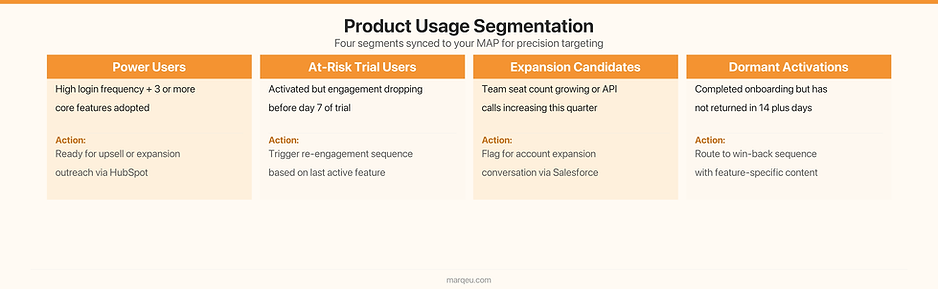
Not every active user represents the same opportunity. A user who logs in daily and has adopted three core features within the first week is a different conversation than one who activated once and has not returned. marqeu mines your product event data to build engagement segments that marketing can use for precision targeting.
Power users who have not yet converted to paid. Trial users who are disengaging before the trial window closes. Existing customers whose team seat count has grown but whose contract has not. Each segment requires a different outreach. marqeu builds the segmentation model and syncs segment membership to your MAP in real time so marketing can act without waiting for a data pull.
Trial-to-Paid Conversion Analytics
Most SaaS companies track whether trial users convert. The analytics that actually improve conversion rates track why users do or do not convert, and surface that intelligence before the trial window closes.
marqeu builds cohort models that track trial engagement from first login through conversion or churn. The model identifies the behavioral predictors of conversion specific to your product: the features adopted, the sequences completed, the time elapsed. Users who diverge from the conversion pattern are flagged so marketing can intervene at the right moment, not after the fact. For benchmark data on what good trial conversion looks like in B2B SaaS, see free trial conversion analytics

Reverse ETL Activation
Analytics that stay in the warehouse do not improve marketing outcomes.
Reverse ETL closes the loop: instead of data flowing only into your warehouse, it pushes modeled insights back out to the tools your marketing and sales teams use every day.
marqeu configures reverse ETL pipelines that sync PQL scores, segment membership, and conversion signals from the warehouse to HubSpot, Marketo, and Salesforce on a defined schedule. A user who crosses the activation threshold at 10 PM is enrolled in a personalized sequence by 10:05. No manual work. No waiting for a weekly data export.

The Data Infrastructure Behind PLG Analytics
The infrastructure behind product-led growth analytics has four layers. Event collection captures user actions from the product through tools like Segment, Amplitude, or Mixpanel. Those events land in a data warehouse: BigQuery, Snowflake, or Databricks. marqeu builds the analytics models in the warehouse using SQL and Python, transforming raw events into scored users, defined segments, and conversion cohorts. Reverse ETL then syncs the output back to HubSpot, Marketo, and Salesforce.
This stack does not require a data engineering team to build or maintain. marqeu brings both the technical implementation capability and the marketing analytics domain expertise to the engagement, covering every layer from event schema review through reverse ETL configuration. For a detailed breakdown of what this infrastructure looks like, the PLG data infrastructure guide covers each layer in depth.

Who This Is For
This service is built for marketing leaders at B2B SaaS companies who already operate a product-led motion, or who are building one, and need the analytics infrastructure to make it work at scale. The typical engagement is with a VP Marketing or CMO at a company between 10 and 500 employees that does not have a dedicated marketing analytics team.
You are the right fit if your product team collects event data but marketing has never been able to access or act on it. If your sales team cannot identify which trial users are activated before they reach out. If you are running a freemium or free trial motion but lack the conversion analytics to understand what is actually driving paid conversion. If you have evaluated building this capability internally and concluded that the faster path is an external partner who has built this infrastructure before.

marqeu has spent 15+ years building B2B marketing analytics infrastructure across software, data, security, and networking companies. The PLG analytics practice is built on that foundation: marketing practitioner expertise combined with technical implementation capability in BigQuery, Snowflake, Databricks, and the reverse ETL layer.
Schedule a Free Marketing Analytics Audit to talk through your current product data infrastructure and what PLG analytics would look like for your GTM motion.
What You Get from a marqeu PLG Analytics Engagement
A completed marqeu PLG analytics engagement delivers four specific outputs: a defined PQL scoring model with documented activation criteria, a product usage segmentation model live in the data warehouse, a trial conversion analytics dashboard tracking cohort behavior from first login through conversion, and a reverse ETL pipeline syncing insights to HubSpot, Marketo, and Salesforce. The full build runs 4 to 6 weeks.

Client example: B2B data platform ($80M ARR, freemium model)
The marketing team had no visibility into which trial users were activated before sales reached out. Outreach was timed to a 14-day trial clock rather than product behavior, and the conversion rate from trial to paid was stagnant. marqeu built a PQL scoring model in BigQuery that analyzed 14 behavioral signals across 90 days of conversion history:
-
The model identified three feature adoption events that predicted 78% of paid conversions.
-
PQL scores began syncing to HubSpot within four weeks.
-
The sales outreach sequence was restructured to trigger on PQL score rather than trial day count.
-
Pipeline from trial users increased 34% in the following quarter.

Frequently Asked Questions About Product-Led Growth (PLG) Analytics
What is product-led growth analytics and how is it different from standard marketing analytics?
Product-led growth analytics mines product usage data: event streams, feature adoption, and login frequency, transforming it into GTM intelligence. Standard marketing analytics measures campaign performance and pipeline attribution. PLG analytics works at the product layer: it scores users based on behavior inside the product and routes those scores to sales and marketing systems via reverse ETL. It requires a data warehouse, SQL or Python analytics models, and reverse ETL infrastructure that standard marketing analytics does not.
What tools does marqeu use for PLG analytics?
marqeu builds on BigQuery, Snowflake, and Databricks for data warehousing. Analytics models run in SQL and Python. Reverse ETL pipelines sync to HubSpot, Marketo, and Salesforce. For event collection, marqeu works with whatever your product team already uses: Segment, Amplitude, Mixpanel, or a custom event pipeline.
How long does a PLG analytics engagement take?
The full build covers PQL scoring model, product usage segmentation, conversion analytics, and reverse ETL activation, and runs 4 to 6 weeks. The timeline depends on the current state of your product event data and whether a data warehouse is already in place.
Do we need a data engineering team to work with marqeu?
No. marqeu brings both the marketing domain expertise and the technical implementation capability under one engagement. The data infrastructure is built and maintained by marqeu. Your marketing team defines the business requirements and the activation criteria. marqeu handles the build.
Ready to unlock your product data?
marqeu works with B2B SaaS marketing teams to build the PLG analytics infrastructure that turns product behavior into pipeline. No data engineering team required.

Get a Free Marketing Analytics Audit
Our complimentary Marketing Analytics Audit is a hands-on, high-value assessment designed to uncover hidden gaps in your current setup and show you where immediate improvements can be made. In this comprehensive review, our experts evaluate your platform connections, data quality, reporting structure, and ROI tracking capabilities. You’ll receive a customized audit report that includes:
-
A platform integration scorecard highlighting systems that are underutilized or disconnected
-
A detailed analysis of your data hygiene and lead lifecycle tracking
-
An evaluation of your current ROI visibility and missed attribution opportunities
-
3–5 high-impact, quick wins you can implement immediately
-
A 90-day roadmap tailored to your team’s tech stack, goals, and business model
This free audit is ideal for B2B marketing teams who are dealing with fragmented data, manual reporting burdens, or a lack of visibility into what’s really driving results. Schedule Your Free Audit Now
Book a 60-Minute Marketing Analytics Strategy Session
If you're a marketing leader managing a significant budget and need personalized guidance, our Marketing Analytics Strategy Session is your chance to get expert insights tailored to your situation. In just 60 minutes, we’ll review your biggest challenges, identify key opportunities, and outline the next steps for building a data-driven marketing engine. During this no-obligation call, we’ll:
-
Discuss the gaps and inefficiencies in your current analytics setup
-
Explore integration opportunities across CRM, MAP, web, and ad platforms
-
Identify ways to improve lead attribution, campaign performance, and ROI tracking
-
Recommend a timeline and investment range aligned to your goals
-
Provide a clear, actionable plan you can start executing right away