

ABM Analytics Consulting: Turn Account Intelligence Into Revenue
Most B2B companies invest heavily in Account-Based Marketing programs orchestrating personalized outreach, aligning sales and marketing, and targeting high-value accounts with precision. Yet when the quarter ends, the most common question in the
boardroom remains unanswered: is ABM actually working?
The problem is not execution. The problem is measurement. Without the right ABM analytics infrastructure, you cannot connect account engagement signals to pipeline creation, attribute revenue to specific ABM plays, or prove the ROI that justifies continued investment. Marketing leaders are left defending budgets with gut feel instead of data. At marqeu, we specialize in building ABM analytics frameworks that answer the hard questions. We help B2B marketing and revenue operations teams design, implement, and continuously optimize the measurement systems that make account-based programs provable, scalable, and accelerated. With 10+ years of experience and 85+ implementations across enterprise and growth-stage B2B companies, we have built a practice specifically around the intersection of ABM strategy and advanced marketing analytics
"The companies winning with ABM are not the ones running the most campaigns. They are the ones who can see, measure, and optimize every touchpoint across the account buying journey and act on that intelligence in real time."

Why ABM Analytics Is the Missing Link in Most B2B Revenue Programs
Account-Based Marketing fundamentally changes how B2B companies go to market. Instead of casting a wide net and hoping for leads, ABM concentrates resources on the accounts most likely to become your best customers. The logic is sound. The results when it works are compelling. But ABM amplifies both successes and failures, which is precisely why measurement becomes so critical.
Traditional marketing analytics were designed for volume-based demand generation. They count leads, measure conversion rates, and attribute success at the individual level. ABM operates differently. Success is measured at the account level, across multi-stakeholder buying committees, over longer sales cycles, and through engagement patterns that often do not look like traditional conversion events.

ABM Demand Waterfall Analytics: How Account-Based Measurement Changes Everything
Most B2B marketing teams measure performance using the traditional demand waterfall a funnel of individual leads moving through stages like Lead, MQL, Meeting Booked, Opportunity, and Closed Won.
This model served demand generation well for decades, but it breaks down the moment ABM enters the picture. The reason is fundamental: ABM is not about individuals. It is about accounts.
And when five contacts from the same company engage with your campaigns, the traditional waterfall counts five leads while your sales team sees one conversation with one account. The ABM Demand Waterfall solves this by abstracting the funnel from individual-level to account-level tracking.
Instead of asking "how many MQLs did we generate this quarter," it asks "how many accounts have reached a marketing-qualified threshold."
Every stage in the traditional waterfall has an account-based equivalent:
-
Leads become Engaged Accounts: companies where one or more contacts have shown measurable engagement with your ABM programs.
-
MQLs become Marketing Qualified Accounts (MQAs): accounts that have crossed a composite engagement and intent threshold across the buying committee, not just a single contact.
-
Meeting Booked becomes Sales Engaged Accounts: accounts where a sales conversation is actively underway, regardless of how many individual meetings have taken place.
-
Active Opportunities: map to Accounts in Pipeline and active deal cycle
-
Closed Won Opportunities: maps to Accounts Won giving leadership a clean view of how many companies, not contacts, converted

This shift in measurement changes how marketing and sales teams evaluate efficiency, coverage, and performance.
A traditional waterfall might show 200 MQLs in a quarter. An ABM demand waterfall for the same period might show 38 Marketing Qualified Accounts and that number tells a fundamentally different story about pipeline quality, buying committee coverage, and sales readiness. marqeu designs and implements ABM demand waterfall frameworks that sit natively inside your CRM and marketing automation stack, giving both marketing and sales a shared, account-level language for pipeline conversations and the analytics infrastructure to optimize every stage of the funnel from Engaged Account to Accounts Won.
When companies try to measure ABM with demand generation metrics, they consistently run into the same problems. They undercount account engagement because they are looking at individual contacts. They misattribute pipeline because they cannot connect marketing touches across a buying committee. They struggle to distinguish between accounts that are engaged and moving and accounts that are stagnant.
The consequences are real.
ABM programs get defunded not because they are not working, but because marketing cannot prove they are working.
Sales teams lose confidence in the accounts marketing flags as "engaged." Revenue operations cannot reconcile what the ABM platform reports with what shows up in CRM. The entire program begins to feel like an expensive experiment rather than a strategic investment. Solving this requires more than better reporting.
It requires a purpose-built ABM analytics architecture one that captures engagement at the account level, tracks buying committee dynamics, integrates intent data with first-party behavioral signals, and surfaces the account intelligence that actually helps sellers close deals.
This is the work marqeu does. We build the measurement infrastructure that makes ABM programs defensible, actionable, and continuously improving.
What Comprehensive ABM Analytics Actually Measures
When we onboard a new ABM analytics client, the first thing we do is audit what is currently being measured and what is not. Most organizations are tracking some combination of account impressions, email open rates, and web visits. These metrics are useful as far as they go, but they represent only the surface layer of what ABM analytics can and should capture. Truly comprehensive ABM measurement operates across four interconnected dimensions.
Account Engagement Scoring:
Engagement scoring in ABM is fundamentally different from lead scoring. You are not evaluating an individual contact's readiness to buy you are building a composite picture of where an entire account sits in its buying journey. This means aggregating signals across every member of the buying committee, weighting those signals by role and recency, and combining first-party behavioral data with third-party intent signals.

At marqeu, we build custom account engagement models that account for your specific GTM motion. A manufacturing company targeting plant operations leads has a different engagement signature than a cybersecurity vendor targeting CISOs. We calibrate the model accordingly and we connect it directly to your CRM so sales teams see account scores where they actually work.
Accounts Selection and Targeting:
Our account based marketing analytics consulting begins with sophisticated account intelligence that goes far beyond basic firmographics data. We leverage advanced B2B marketing analytics frameworks to identify high-value prospects, analyze historical win patterns, and map total addressable market opportunities across your ideal customer segments. Our proprietary account scoring methodology combines intent data, engagement signals, and buying committee analysis to create precise target account lists that deliver 3x higher conversion rates than traditional approaches. Through comprehensive sales and marketing alignment workshops, we ensure your teams are equipped with actionable insights that drive meaningful conversations and accelerated deal cycles.
What sets our ABM analytics approach apart:
-
Comprehensive account modeling using advanced analytics algorithms
-
Intent signal analysis across 50+ data sources
-
Buying committee mapping and persona intelligence
-
Competitive landscape analysis for strategic positioning
-
ROI forecasting and performance benchmarking
Content Strategy & Personalization:
Effective ABM analytics transforms generic content marketing into precision-targeted engagement that resonates with specific accounts and buying personas. Our content intelligence framework combines behavioral analytics, engagement scoring, and attribution modeling to optimize every touchpoint in your ABM journey. We help you move beyond spray-and-pray content tactics to create account-specific experiences that drive measurable engagement. Our advanced marketing analytics framework tracks content performance across multiple dimensions from initial awareness through final conversion providing clear insights into which messages resonate with different persona types, industries, and buying stages.
Pipeline Attribution at the Account Level:
One of the most powerful and most frequently missing capabilities in ABM analytics is multi-touch attribution at the account level. You need to know which ABM plays, channels, and content pieces influenced pipeline creation and velocity. Not just which campaign a contact clicked, but which combination of marketing touches moved an account from target to opportunity.

We implement account-level attribution models using tools like Snowflake and Census that unify your CRM data, marketing automation events, advertising touchpoints, and intent data into a single account timeline. This gives you the ability to see, for the first time, which parts of your ABM program are genuinely moving accounts and which are generating activity without advancing opportunities.
Buying Committee Coverage and Influence:
B2B buying decisions involve an average of 6 to 10 stakeholders, and ABM programs are specifically designed to engage multiple personas within target accounts. Yet most reporting treats accounts as single entities. You cannot tell whether you are reaching the right people, whether you have economic buyer coverage, or whether a deal is at risk because a key stakeholder has gone dark.

Our ABM analytics frameworks map buying committee dynamics explicitly. We build persona-level engagement tracking so you can see not just that an account is engaged, but whether the CFO is engaged alongside the operational champion. This intelligence changes how sales teams prioritize accounts and how marketing deploys resources.
Automation & Orchestration:
Successful Account Based Marketing (ABM) analytics requires sophisticated automation that responds intelligently to account behavior and engagement patterns. It is all about bringing together the systems across the sales and marketing tech stack to operate in resonance.
-
Analytics-Driven Lead Routing & Notification Systems:
Our consulting approach designs automated workflows that trigger based on analytical insights, ensuring timely and contextually relevant engagement across all touchpoints. We enable routing intelligence analyzes account engagement patterns, contact roles, and buying stage indicators to ensure the right sales resources engage at optimal moments. This analytical approach improves lead response times and increases conversion rates.
-
Behavioral Trigger Analytics:
We implement advanced behavioral tracking that monitors account-level engagement across email, web, social, and advertising channels. Our algorithms identify buying signal combinations that indicate sales readiness, automatically triggering appropriate sales actions and personalized content delivery.
-
Account Journey Analytics:
Understanding the complex path accounts take through your marketing and sales process is crucial for optimization. Our journey analytics platform maps individual account progression, identifies bottlenecks, and recommends strategic interventions to accelerate conversion.
Program ROI and Channel Effectiveness
Ultimately, ABM analytics must connect activity to outcomes. Which target account lists performed best? What is the pipeline contribution of your ABM advertising versus your executive engagement programs versus your content syndication? What is the average sales cycle length for accounts compared to non-ABM accounts, and what is the closed-won rate differential? Transform raw ABM data into strategic intelligence that drives revenue growth and executive confidence. Our account based marketing (ABM) analytics and reporting goes beyond basic metrics to provide deep insights into program effectiveness, market dynamics, and optimization opportunities.
-
Executive ABM Analytics Dashboard:
Our custom reporting platform provides C-level executives with clear visibility into ABM program ROI, pipeline impact, and strategic account progression. Key metrics include account penetration rates, deal velocity improvements, average deal size impact, and competitive win rates all benchmarked against industry standards.
-
Account-Level Performance Intelligence:
Detailed analytics for individual strategic accounts show engagement patterns, buying committee involvement, content consumption preferences, and conversion probability. This intelligence enables sales teams to approach conversations with data-driven confidence and personalized value propositions.
-
Multi-Touch Attribution & Revenue Analytics:
Our advanced attribution modeling accurately connects ABM activities to revenue outcomes across extended B2B buying cycles. This capability is crucial for proving ABM ROI and optimizing budget allocation across channels and tactics.
Client Success: ABM Analytics Transformation Stories
Theory only goes so far. Here is what ABM analytics transformation looks like in practice, drawn from real implementations across marqeu's consulting portfolio.
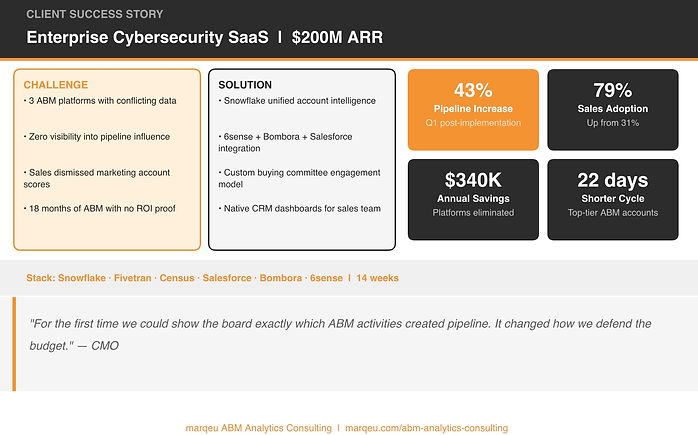
Enterprise Cybersecurity SaaS | $200M ARR
-
Challenge: Running ABM for 18 months with zero confidence in what was working. Three separate platforms reporting different engagement numbers, no way to connect ABM activity to pipeline, sales team dismissing marketing's account prioritization as unreliable.
-
Solution: Built a unified account intelligence layer in Snowflake combining Bombora intent data, 6sense behavioral signals, Salesforce opportunity data, and Marketo engagement events. Implemented custom account engagement scoring with role-weighted buying committee coverage. Deployed real-time account dashboards in Salesforce so sales saw ABM intelligence natively.
-
Results: 43% increase in ABM-influenced pipeline in Q1 post-implementation. Sales adoption of account prioritization improved from 31% to 79%. Eliminated 2 redundant ABM platforms saving $340K annually. Average sales cycle for top-tier ABM accounts shortened by 22 days.
-
Timeframe: 14 weeks to production | Ongoing optimization
B2B SaaS for Financial Services | $85M ARR
-
Challenge: CMO could not answer board questions about ABM ROI. Attribution model treated ABM and demand-gen the same way, understating ABM contribution. Sales questioned whether ABM accounts were meaningfully different from non-ABM accounts in terms of deal quality.
-
Solution: Implemented account-level multi-touch attribution model separating ABM-influenced versus non-ABM pipeline. Built executive dashboard showing win rate, deal size, and sales cycle comparisons across ABM tiers. Integrated LinkedIn Campaign Manager and G2 buyer intent data into unified account profiles.
-
Results: ABM accounts showed 2.4x higher average deal size and 34% higher win rate than non-ABM accounts data that had always been true but never visible. CMO used findings to secure 40% ABM budget increase for following fiscal year. New attribution model identified $4.2M in previously unattributed pipeline.
-
Timeframe: 10 weeks to initial reporting | Quarterly optimization cadence

The marqeu ABM Analytics Framework: Four Phases to Measurement Maturity
After implementing ABM analytics for dozens of B2B companies, we have developed a structured approach that consistently delivers results. Our framework moves organizations from fragmented, unreliable ABM measurement to integrated, actionable account intelligence.
Phase 1: ABM Analytics Audit and Architecture Design (Weeks 1–3)
Every engagement begins with a thorough assessment of your current state. We evaluate your existing ABM tech stack, audit data flows between platforms, identify measurement gaps, and map your current reporting against what leadership actually needs to know. This phase surfaces the specific gaps between what you are measuring and what would actually prove ABM impact.
From this audit, we design your target analytics architecture specifying how data will flow from your ABM platforms, CRM, marketing automation, advertising systems, and intent data providers into a unified account intelligence layer. We present this architecture before writing a single line of code, ensuring alignment with IT, sales operations, and marketing leadership.
Phase 2: Data Integration and Warehouse Implementation (Weeks 4–8)
With architecture approved, we build the data infrastructure that makes unified ABM analytics possible. For most clients, this means implementing or optimizing a cloud data warehouse (Snowflake or BigQuery) as the central layer, connecting data pipelines using Fivetran or custom ETL processes, and transforming raw event data into account-level analytics using dbt.
This phase establishes the single source of truth that your entire ABM measurement framework will rely on. We build it to be flexible enough to accommodate new data sources as your ABM program evolves, and governed enough that data quality issues do not contaminate your reporting.

Phase 3: Analytics Layer and Dashboard Development (Weeks 9–12)
With clean, unified data in place, we build the analytics layer: account engagement scoring models, attribution frameworks, pipeline influence reporting, and the executive and operational dashboards that make insights accessible to every stakeholder who needs them.
We are deliberate about deployment surface. Sales teams get ABM intelligence embedded in Salesforce or HubSpot where they actually work. Marketing gets operational dashboards that support campaign optimization decisions. Executives get the pipeline attribution and ROI reporting that answers board-level questions. We build for adoption, not just for technical correctness.
Phase 4: Optimization and Continuous Improvement (Ongoing)
ABM analytics is not a one-time implementation. As your target account lists evolve, new channels are added, and your understanding of buyer behavior deepens, the analytics framework needs to evolve with it. We offer ongoing engagement models that include quarterly model recalibration, new data source integration, and regular business reviews to ensure the analytics continue to drive decisions and not just generate reports.
The ABM Analytics Technology Stack: What Works and Why
One of the most common questions we receive from new clients is whether they need to buy new technology before they can build effective ABM analytics. The answer is almost always no. The problem is rarely a missing tool, it is a missing integration layer that connects the tools they already have. That said, there are platform categories where investment genuinely accelerates ABM measurement maturity, and categories where organizations routinely over-invest relative to the value they receive.
Intent Data Platforms:
Intent data is foundational to ABM analytics because it extends your visibility beyond first-party behavioral signals to include research activity happening across the broader web. Bombora, G2 Buyer Intent, and TechTarget Priority Engine are the platforms we most commonly implement and integrate. The key is not picking the right platform it is connecting intent signals to your account engagement scoring model and CRM so they are actionable, not just informational.
ABM Execution Platforms:
6sense and Demandbase are the dominant enterprise ABM platforms, and both have meaningful analytics capabilities built in. We are not neutral on which is better for a given use case it depends on your sales motion, deal size, and existing tech stack. What we consistently find is that organizations underuse the analytics capabilities of whichever platform they have chosen, and they almost always benefit from connecting that platform's data into a broader measurement infrastructure rather than relying on it as a standalone reporting source.

Cloud Data Warehouses:
Snowflake and Google BigQuery are the platforms where we most frequently build the unified account intelligence layer. Both handle the volume and variety of ABM data well. The choice often comes down to your broader data infrastructure and IT preferences. What matters more than platform choice is the data modeling approach we use dbt to build clean, documented, account-level data models that make downstream analytics reliable and maintainable.
CRM Integration:
The most undervalued integration in most ABM analytics implementations is the one between the analytics layer and CRM. All the sophisticated engagement scoring in the world creates limited value if sales teams cannot see it where they work. We implement CRM-native ABM analytics using Census for reverse ETL, pushing account scores, engagement signals, and buying committee coverage directly into Salesforce or HubSpot records. This is consistently one of the highest-impact elements of our implementations.
The 7 Most Costly ABM Analytics Mistakes B2B Companies Make
Across all the implementations, we have seen the same mistakes appear repeatedly. Understanding them is the first step toward avoiding them.
-
The most pervasive mistake is measuring ABM programs with demand-generation metrics. Impressions, MQLs, and email open rates were designed for volume-based marketing. Applying them to ABM creates a fundamental measurement mismatch that makes good programs look mediocre and bad programs look fine.
-
The second mistake is treating accounts as single entities in reporting. When you aggregate all contacts at an account into a single engagement score without considering their roles, you lose the buying committee intelligence that ABM is specifically designed to generate. A program director clicking on your content is a different signal than a CFO visiting your pricing page.
-
The third mistake is building ABM analytics in the ABM platform itself. Platforms like 6sense and Demandbase are excellent execution tools, but they are not built to serve as the authoritative source of ABM performance data. They do not have visibility into what happens after a deal enters the CRM, they cannot easily incorporate data from sources outside their ecosystem, and they are not designed to produce the board-level attribution reporting most marketing leaders need.

4.The fourth mistake is ignoring data quality at the foundation. ABM analytics is only as good as the data underneath it. Account matching, contact-to-account association, and CRM data hygiene are boring but essential prerequisites. We spend significant time in every engagement on these foundations because skipping them produces analytics that look sophisticated but are fundamentally unreliable.
5.The fifth mistake is building analytics for marketers only. The most effective ABM analytics systems deliver intelligence to sales teams in ways that change how they prioritize and approach accounts. If your ABM analytics live exclusively in marketing dashboards, you are getting half the value.
6.The sixth mistake is using static account lists without dynamic measurement. Your Ideal Customer Profile evolves. Market conditions change. Accounts move in and out of buying mode. ABM analytics should inform how account lists are constructed and refreshed not just measure what happens to fixed lists.
7.The seventh mistake is treating implementation as a project rather than a capability. ABM analytics requires ongoing maintenance, model recalibration, and continuous alignment between what is being measured and what leadership needs to know. Organizations that treat implementation as a one-time project consistently see measurement drift over time.
Building the Business Case for ABM Analytics Investment
Marketing leaders considering an investment in ABM analytics infrastructure often face internal skepticism. Finance wants to know the ROI. IT wants to know the integration complexity. Sales wants to know how it will change their workflow. These are legitimate concerns, and answering them requires a clear articulation of the value at stake.
The business case for ABM analytics investment rests on four value drivers:
-
The first is efficiency: better measurement identifies which ABM activities are generating pipeline and which are generating activity without advancing opportunities, enabling reallocation of budget toward higher-performing plays. Our clients consistently identify 15 to 30 percent of ABM spend that can be reallocated or eliminated based on performance data.
-
The second value driver is sales velocity. When sales teams have real-time account intelligence knowing which accounts are in buying mode, which personas are engaged, and where buying committee coverage is thin they prioritize differently. We have seen average sales cycle reductions of 15 to 25 percent when account intelligence is delivered effectively to sellers.

-
The third driver is defensibility. ABM programs are expensive to run and require ongoing executive support. Marketing leaders who can show pipeline attribution, win rate comparison, and deal size differential for ABM accounts versus non-ABM accounts are far better positioned to defend and grow their programs than those relying on activity metrics.
-
The fourth driver is speed. Organizations with mature ABM analytics optimize their programs quarterly rather than annually. They can see what is working within a campaign cycle, adjust targeting and messaging based on engagement signals, and continuously improve program performance rather than waiting for year-end reviews to learn what failed.
In our experience, the fully-loaded cost of an ABM analytics implementation including infrastructure, consulting, and ongoing optimization is recovered within the first year for virtually every client, often in the first two quarters.
Why B2B Marketing Leaders Choose marqeu for ABM Analytics
There is no shortage of firms willing to help with marketing analytics. What distinguishes marqeu is the combination of technical depth, ABM specialization, and GTM alignment that characterizes every engagement.
We are not a general-purpose analytics firm that handles ABM as one of dozens of service lines. ABM analytics and B2B marketing operations broadly is our practice. Our consultants have implemented ABM analytics programs at companies ranging from Series B startups building their first measurement infrastructure to enterprise organizations with complex, multi-platform ABM stacks. We bring pattern recognition from this breadth of experience to every client engagement.

We believe, fundamentally, that marketing should dictate how technology facilitates measurement not the other way around.
Too many ABM analytics implementations are driven by what the tools make easy to measure rather than by what leaders actually need to know to run their programs effectively. We start with the business questions and work backward to the technical implementation. We are also opinionated about delivery. We do not hand clients a spec document and disappear. We build alongside your team, transfer knowledge throughout the engagement, and structure our work so your internal team can maintain and extend what we build. Our goal is to make your organization more capable, not more dependent.
Finally, we measure our success by yours. The metrics we care about are the ones that matter to your board: pipeline attributed to ABM, win rates for target accounts, sales cycle velocity, and program ROI. We are not done when the dashboard goes live. We are done when the data is driving decisions.
Frequently Asked Questions About ABM Analytics
What is the difference between ABM analytics and traditional marketing analytics?
Traditional marketing analytics is designed for volume-based demand generation it counts leads, measures individual conversion rates, and attributes success at the person level. ABM analytics operates at the account level, tracking engagement across entire buying committees, measuring account-level pipeline influence, and connecting marketing activity to revenue outcomes for specific target accounts. The measurement model, the metrics, and the infrastructure requirements are fundamentally different.
How long does it typically take to implement ABM analytics?
Most marqeu ABM analytics implementations run 10 to 14 weeks from kickoff to production dashboards. The timeline depends on the complexity of your existing tech stack, the quality of your CRM data, and the scope of integration required. Phase 1 (audit and architecture) typically takes 2 to 3 weeks. Phase 2 (data integration and warehouse) takes 4 to 5 weeks. Phase 3 (analytics layer and dashboards) takes 3 to 4 weeks. Ongoing optimization begins immediately after go-live.
Do we need to invest in new ABM technology before implementing analytics?
In most cases, no. The majority of our clients already have the core ABM tools in place an ABM execution platform, CRM, marketing automation, and some form of intent data. What they are missing is the integration layer that connects these systems into a unified measurement infrastructure. We build that layer using the tools you already have, augmented by a cloud data warehouse as the central analytics hub.
How do you handle the attribution question between ABM programs and other demand generation activities?
Attribution is one of the most nuanced challenges in B2B marketing analytics, and it is particularly complex in environments where ABM programs run alongside traditional demand generation. Our approach is to build account-level attribution models that can distinguish ABM-influenced pipeline from non-ABM pipeline, while also acknowledging that the two are often complementary rather than competing. We implement models that are defensible, transparent, and specifically calibrated to your GTM motion not one-size-fits-all attribution logic borrowed from B2C or demand-gen contexts.
Can ABM analytics integrate with our existing CRM and marketing automation platforms?
Yes CRM and marketing automation integration is central to everything we build. We work extensively with Salesforce and HubSpot on the CRM side, and Marketo, HubSpot, and Pardot on the marketing automation side. A core part of our implementation is ensuring that ABM analytics are accessible within the platforms your sales and marketing teams already use, not just in a separate analytics environment that gets checked once a week.
What metrics should we use to measure ABM program success?
The most meaningful ABM metrics fall into four categories: engagement quality (account engagement score, buying committee coverage, intent signal strength), pipeline contribution (ABM-influenced pipeline, pipeline velocity for target accounts, opportunity creation rate from tier-one accounts), revenue impact (closed-won rate comparison for ABM versus non-ABM accounts, average deal size, sales cycle length), and program efficiency (cost per engaged account, cost per ABM-influenced opportunity, channel effectiveness by ABM play). We help clients define the specific metric set that aligns with their board-level questions and their sales team's decision-making needs.
Ready to Build ABM Analytics That Actually Drive Revenue?
If you are running an ABM program without confidence in what is working, or if you are preparing to defend your ABM investment and need data to make the case, marqeu is ready to help.
We begin every engagement with a complimentary ABM analytics assessment a structured 60-minute review of your current measurement capabilities, your key business questions, and the highest-impact opportunities to improve your analytics infrastructure. There is no commitment required, and most clients leave with a clear picture of their measurement gaps and a prioritized roadmap for addressing them.

Get a Free Account Based Marketing (ABM) Analytics Audit
Our complimentary Marketing Analytics Audit is a hands-on, high-value assessment designed to uncover hidden gaps in your current setup and show you where immediate improvements can be made. In this comprehensive review, our experts evaluate your platform connections, data quality, reporting structure, and ROI tracking capabilities. You’ll receive a customized audit report that includes:
-
A platform integration scorecard highlighting systems that are underutilized or disconnected
-
A detailed analysis of your data hygiene and lead lifecycle tracking
-
An evaluation of your current ROI visibility and missed attribution opportunities
-
3–5 high-impact, quick wins you can implement immediately
-
A 90-day roadmap tailored to your team’s tech stack, goals, and business model
This free audit is ideal for B2B marketing teams who are dealing with fragmented data, manual reporting burdens, or a lack of visibility into what’s really driving results. Schedule Your Free Audit Now
Book a 30-Minute Account Based Marketing (ABM) Analytics Strategy Session
If you're a marketing leader managing a significant budget and need personalized guidance, our Marketing Analytics Strategy Session is your chance to get expert insights tailored to your situation. In just 30 minutes, we’ll review your biggest challenges, identify key opportunities, and outline the next steps for building a data-driven marketing engine. During this no-obligation call, we’ll:
-
Discuss the gaps and inefficiencies in your current analytics setup
-
Explore integration opportunities across CRM, MAP, ABM, Product Engagement, web, and ad platforms
-
Identify ways to improve lead attribution, campaign performance, and ROI tracking
-
Recommend a timeline and investment range aligned to your goals
-
Provide a clear, actionable plan you can start executing right away
This session is perfect for B2B teams with Account Based Marketing (ABM) as a strategic initiative and want to stop guessing and start making confident, data-backed decisions. Book Your Strategy Session
Don’t Just Track Data.Turn It Into Growth
If you're ready to bridge the gap between marketing activity and revenue performance, our team is ready to help. Whether you're just starting to connect systems or need to overhaul your entire analytics framework, our services are built to meet you where you are and take you further. Let’s connect. Your marketing data should work harder. We’ll show you how.
Schedule Your Free Audit.