
Salesforce.com Professional Services and Expert Consulting

Salesforce is the backbone of almost every B2B revenue organization running at scale today. It sits at the center of how marketing generates demand, how sales pursues pipeline, and how leadership measures what is actually working. And yet, across the hundreds of marketing and revenue operations teams we have worked with, the same frustration comes up again and again: the platform is deeply powerful, and deeply underutilized.
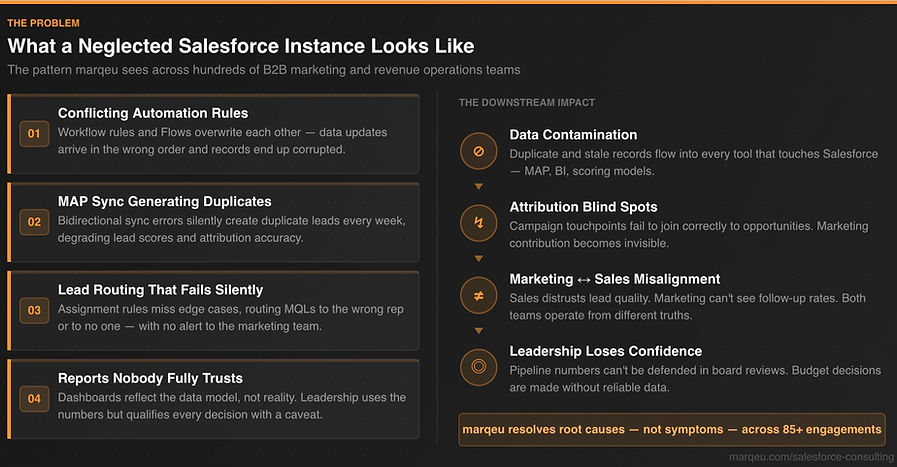
Teams are running on a Salesforce instance that was stood up years ago, configured for a GTM motion that no longer applies, and maintained by whoever happened to be around when something broke. Lead routing rules conflict with each other. Custom fields that nobody uses clutter every page layout. Integration sync errors between Salesforce and the marketing automation platform go unnoticed for weeks, contaminating pipeline data that leadership is making decisions from. Reports look like numbers but nobody fully trusts them.
At marqeu, Salesforce CRM consulting is not just an add-on service. It is core to everything we do because for all kinds of marketing analytics projects, most of the data is generated and accessed via Salesforce CRM.
We are a B2B marketing analytics, operations and revenue operations consulting firm built from the ground up by practitioners who have spent their careers inside the Salesforce ecosystem. Our Salesforce consulting practice is specifically designed for marketing and revenue operations teams that need the platform to perform, not just exist. We have completed 85+ Salesforce implementations and optimization engagements across high-growth SaaS, fintech, healthcare technology, and enterprise software organizations, and we bring that depth of experience to every engagement we take on.
This page covers what our Salesforce CRM consulting services include, how we work, what results our clients have achieved, and why choosing a marketing operations-native Salesforce implementation partner makes a fundamental difference in what you get out of the platform.
What Salesforce CRM Consulting Actually Means for Marketing and Revenue Operations Teams
Salesforce consulting covers a wide territory. At the most basic end, it means someone who can configure fields and page layouts. At the most complex end, it means a strategic partner who understands how the platform intersects with your entire GTM motion and can architect solutions that make your marketing, sales, and customer success teams more effective.
What distinguishes marqeu's Salesforce consulting practice is that we approach the platform from a marketing analytics operations and revenue operations lens first.
Most Salesforce consulting firms come from a sales operations background. They think in terms of deal stages, opportunity fields, and forecasting models. Those are important, but
for B2B marketing teams, the real value of Salesforce lies in something different: its role as the single source of truth that connects marketing activity to pipeline and revenue.

When Salesforce is properly configured for a B2B marketing and revenue operations organization, it becomes the infrastructure that makes everything else work:
-
Database Management gets clean because data enters the system correctly and syncs accurately with the marketing automation platform.
-
Lead Scoring becomes reliable because the behavioral and firmographic data feeding the scoring model is structured correctly in Salesforce.
-
Marketing Attribution is trustworthy because campaign and touchpoint data is captured with fidelity and joined correctly to opportunities.
-
Marketing Analytics reflects reality because the data model was designed to mirror how your business actually runs.
That is the version of Salesforce we build. Not the generic, out-of-the-box configuration that ships with every new org. A Salesforce instance that is purpose-built for the way your marketing and revenue teams operate, integrated tightly with your marketing technology stack, and maintained with the discipline that makes data-driven decision-making actually possible.
Our Salesforce CRM Consulting Services: What We Deliver
marqeu's Salesforce consulting practice is organized around the capabilities that matter most for B2B marketing operations and revenue operations teams. Here is what we do and how we approach each area.
1. Salesforce Implementation from the Ground Up
For organizations implementing Salesforce for the first time, the decisions made in the first few weeks determine whether the platform will serve your team well for years or create technical debt that compounds every quarter. We have seen organizations spend 18 months undoing implementation mistakes that could have been avoided with proper planning at the outset.
Our Salesforce implementation process starts with an intensive discovery phase where we map your entire lead-to-revenue process before we touch a single configuration setting. We document every stage, every handoff, every data requirement, and every reporting need. We then design a Salesforce data model and architecture that reflects your actual GTM motion, not Salesforce's generic default. Implementation includes:
-
Lead and contact object configuration with all custom fields, validation rules, and page layouts designed for your team's workflow
-
Account and opportunity data model design including custom fields, record types, and page layouts aligned to your sales process
-
User roles, profiles, and permission sets structured to give every team member exactly the access they need
-
Custom lead routing logic including territory-based assignment, round-robin distribution, and priority routing rules
-
Sales process automation using Salesforce Flow to enforce process steps, update records, and trigger notifications
-
Salesforce and marketing automation platform integration setup covering Marketo, HubSpot, Pardot, or Eloqua depending on your stack
-
Initial reports and dashboards for marketing pipeline contribution, lead velocity, funnel conversion rates, and sales activity
-
Data import and migration from legacy CRM systems with deduplication and field mapping
Our typical implementation timeline for a B2B marketing and revenue operations team is 6 to 10 weeks depending on complexity and data migration scope. We deliver a platform that is ready to use on day one and designed to scale as your organization grows.

2. Salesforce CRM Optimization and Org Cleanup
Most of the Salesforce engagements we take on are not greenfield implementations. They are rescue operations. Organizations come to us with Salesforce instances that have been configured and reconfigured by multiple admins over multiple years, with layers of automation that contradict each other, data that nobody fully trusts, and a platform that feels more like a burden than an asset.
Our Salesforce org optimization engagement begins with a comprehensive audit. We evaluate your current configuration across every dimension that matters for marketing and revenue operations: data quality, automation health, integration fidelity, reporting accuracy, security model, and process alignment. We then prioritize issues by business impact and build a remediation roadmap that sequences fixes in the order that delivers the most value fastest.
Common issues we resolve in optimization engagements include conflicting workflow rules and process flows that are overwriting each other, lead assignment rules that are routing incorrectly or failing silently, integration sync errors between Salesforce and the MAP that are causing lead data to be duplicated or lost, custom validation rules that are blocking legitimate updates, and reports built on incorrect field logic that are producing misleading numbers. In every case, we fix the root cause, not the symptom, and we document every change so your team knows exactly what is running and why.

3. Salesforce and Marketing Automation Integration
The integration between Salesforce and the marketing automation platform is the most operationally critical connection in the B2B marketing technology stack. When it works correctly, lead data flows bidirectionally without errors, campaign attribution data lands on the right records, and marketing and sales are working from a single version of the truth. When it does not work correctly, the consequences cascade across every function that depends on accurate data.

We have set up and repaired Salesforce integrations with every major B2B marketing automation platform including Marketo, HubSpot, Pardot (now Salesforce Account Engagement), Eloqua, and Salesloft, Outreach. Our integration work covers the full scope of what a properly functioning connection requires: sync field mapping with proper data type alignment, sync error monitoring and alerting, campaign member status management, lead-to-contact conversion handling, and the permission configurations that ensure data updates flow correctly in both directions.
Beyond the core MAP integration, we also implement and repair connections to third-party platforms including ABM platforms like 6sense and Demandbase, data enrichment tools like ZoomInfo and Clearbit, marketing analytics and business intelligence infrastructure including Tableau, Looker, and Sigma, attribution platforms, webinar tools, and intent data providers. Every integration we implement is tested end-to-end before go-live, with monitoring in place so errors are surfaced immediately rather than discovered weeks later when the damage to data quality is already done.
4. Advanced Salesforce Automation: Flows, Workflows, and Custom Rules
The gap between what most organizations get out of Salesforce automation and what is possible is enormous. Most teams are running on a combination of legacy workflow rules built years ago and a handful of flows added more recently, with little documentation and significant redundancy. Critical process steps that should be automatic are still being done manually. Field updates that should happen in real time require someone to remember to do them.

At marqeu, we design and build Salesforce automation that reflects the full complexity of your B2B revenue process and the GTM strategy that is unique to your organization.
This includes Salesforce Flow-based lead routing with multi-condition logic, on-the-fly lead-to-account matching for ABM programs, opportunity stage progression automation with automatic task and notification creation, custom validation rules that enforce data quality at the point of entry, and auto-triggered alerts for SLA monitoring across marketing and sales handoff points.
One of the most impactful automation use cases we implement repeatedly across engagements is SLA-based lead follow-up enforcement. Marketing teams invest significant resources generating leads, and sales follow-up speed is one of the strongest predictors of conversion rate. We build Salesforce automation that monitors lead age, triggers escalation alerts when SLAs are breached, and captures follow-up timing data so marketing can report on the actual speed of sales response. The result is accountability on both sides of the marketing-sales handoff that drives measurable pipeline improvement.
5. Salesforce Reporting, Dashboards, and Marketing Analytics
Our background in marketing analytics means we approach Salesforce reporting differently from most Salesforce consulting firms. We are not building reports to check a box. We are building the measurement infrastructure that marketing and revenue leaders use to make decisions, defend budgets, and understand what is driving growth.

The reports and dashboards we build for marketing operations teams cover the full lead-to-revenue funnel: lead volume and quality by source, funnel conversion rates at every stage, pipeline generation by marketing channel and campaign, lead velocity and time-in-stage analysis, marketing-attributed pipeline and revenue, SLA compliance tracking, and data quality monitoring. For revenue operations teams, we layer in sales activity analytics, forecast accuracy reporting, deal inspection dashboards, and territory performance views.
Where Salesforce's native reporting reaches its limits, we extend it. We use custom objects and data snapshots to enable historical trend analysis on pipeline data. We build custom fields that capture calculated metrics not available natively. We connect Salesforce data to external BI tools including Tableau, Looker, and Sigma for organizations that need cross-platform analytics beyond what Salesforce can provide on its own. The goal in every engagement is reporting that marketing and sales leaders actually use and trust, not reports that get pulled once a quarter and questioned.
6. Salesforce Data Management and Database Health
Data quality is not a Salesforce feature. It is a discipline that has to be designed into the platform from the beginning and maintained with ongoing attention. In the absence of that discipline, Salesforce databases accumulate duplicate records, incomplete records, stale records, and inconsistent field values that degrade the quality of every process that depends on clean data.

Our Salesforce data management services cover the full lifecycle of database health.
We implement deduplication processes that prevent duplicate creation at the point of entry through validation rules and matching rules, and resolve existing duplicates systematically using merge logic that preserves the right record values. We build normalization automation that standardizes field values for key dimensions like industry, geography, company size, and persona. We set up ongoing data quality monitoring reports that surface degradation before it compounds. And we implement the field-level validation and required field logic that enforces data completeness on records that matter most.
Clean data in Salesforce has a multiplier effect across the entire technology stack.
Lead scoring becomes more accurate when the firmographic and behavioral data feeding the model is complete and consistent. Segmentation in the MAP becomes more precise. Attribution analysis becomes more reliable. Sales prioritization improves. The investment in getting Salesforce data right pays dividends across every marketing and sales function that depends on it.
7. Salesforce Managed Services and Ongoing Administration
Many B2B marketing and revenue operations teams do not have the internal capacity to maintain a complex Salesforce org at the level it requires. A dedicated, senior Salesforce administrator costs $90,000 to $130,000 per year in most markets, and qualified administrators are difficult to hire and retain. For teams that need expert-level Salesforce administration without the overhead of a full-time hire, our managed services model provides ongoing support, administration, and optimization on a retainer basis.
Our Salesforce managed services cover day-to-day administration including user management, field and page layout updates, report and dashboard creation, workflow and flow maintenance, integration monitoring, and data quality oversight. We also provide strategic guidance on Salesforce roadmap decisions, new feature rollouts, and platform upgrade planning. Clients on a managed services retainer get a dedicated marqeu consultant who knows their specific Salesforce configuration deeply, responds quickly to operational needs, and proactively identifies optimization opportunities.
Client Results: What B2B Marketing and Revenue Operations Teams Achieve with marqeu's Salesforce Consulting
The results our clients achieve from Salesforce consulting engagements are not measured in configuration complexity. They are measured in pipeline impact, operational efficiency, and the quality of decisions that marketing and revenue leaders can make. Here are three representative examples.

Case Study: Enterprise SaaS
Challenge: This cybersecurity software company had a Salesforce instance that had been configured by three different admins over six years, with 14 active integrations, conflicting lead routing rules, and a marketing automation sync that was generating approximately 2,400 duplicate records per quarter. The VP of Marketing could not produce a reliable marketing-influenced pipeline number because campaign attribution data was inconsistent across the org. The sales team was spending an estimated 6 hours per week resolving data quality issues instead of selling.
Solution: marqeu conducted a full Salesforce org audit over three weeks, mapping every active automation, integration, and routing rule. We rebuilt the lead routing logic from scratch using Salesforce Flow, eliminating conflicts and implementing territory-based assignment with proper override controls. We repaired the Marketo sync, implementing duplicate prevention at the point of entry and running a systematic deduplication of the existing database. We rebuilt the campaign data model to capture first-touch, last-touch, and multi-touch attribution data correctly for every lead and contact, and created a set of pipeline dashboards that gave marketing leadership a reliable view of contribution.
Results:
-
Duplicate record creation reduced by 94% within 30 days of go-live.
-
Marketing-attributed pipeline reporting went from a number nobody trusted to the primary metric used in weekly leadership reviews.
-
Sales team data resolution time dropped from 6 hours per week to under 30 minutes.
-
The organization attributed $8.4M in pipeline to marketing programs in the first quarter post-implementation that would previously have been invisible in reporting.
-
Implementation timeline: 11 weeks.

Case Study: Fintech SaaS, Series C
Challenge: This payments infrastructure company had just completed a Series C round and was scaling their marketing team from 4 to 14 people. Their Salesforce instance was configured for a 10-person organization and could not support the ABM program, the expanded campaign operation, or the attribution reporting the new CMO needed to run the business. Lead scoring was nonexistent. Lead-to-account matching for ABM target accounts was being done manually in spreadsheets. Sales had no visibility into marketing engagement data at the account level.
Solution: We rebuilt the Salesforce data model to support an account-centric ABM motion, implementing lead-to-account auto-matching using custom Flow logic that handled both known contacts and net-new leads from target accounts. We integrated Salesforce with 6sense for intent data and built account-level engagement scoring visible to sales reps on every account record. We implemented a multi-touch attribution model using custom campaign member objects and built a suite of account engagement dashboards. We also set up Salesforce Data Cloud connectivity for unified customer profile data.
Results:
-
100% of inbound leads from ABM target accounts automatically matched to the correct account record within 60 seconds of creation.
-
Sales team adoption of marketing engagement data in account review meetings went from 0% to 80% within the first month.
-
Marketing pipeline contribution reporting was stood up in week 8 of the engagement.
-
The CMO had a fully defensible marketing attribution view for the board within 90 days of engagement start.
-
Implementation timeline: 14 weeks.
Why marqeu as Your Salesforce Implementation Partner for Marketing Operations
The Salesforce partner ecosystem is large and varied. Choosing the right Salesforce implementation partner for a marketing operations or revenue operations team requires understanding what actually differentiates firms in practice. Here is what makes marqeu a different kind of Salesforce consulting firm.
We Were Built for B2B Marketing Analytics and Operations, Not Repurposed for It
marqeu was founded by marketing operations practitioners. The consultants we put on Salesforce engagements have spent their careers running marketing operations functions, not just consulting on them. They understand the difference between a Salesforce configuration that looks correct and one that actually supports marketing-to-sales-to-revenue workflow at scale. They know what breaks when the MAP sync is misconfigured. They understand the reporting requirements of a marketing team trying to defend pipeline contribution to the CFO. That practitioner background is not something we acquired. It is what we are.

We Think in Systems, Not Features
Every Salesforce decision we make is evaluated against its impact on the broader marketing technology stack. We do not configure fields in isolation. We configure them knowing how they will sync to the MAP, how they will appear in reports, how they will affect lead routing logic, and how they will be used by sales reps on a day-to-day basis. That systems thinking prevents the category of problem that most Salesforce engagements create without realizing it: the fix that works in isolation and breaks three things downstream.
10+ Years of Salesforce Experience Across Every Major Marketing Technology Integration
Over more than a decade of engagements, we have implemented Salesforce integrations with every platform in the B2B marketing technology ecosystem. Marketo, HubSpot, Pardot, Eloqua, Outreach, Salesloft, 6sense, Demandbase, ZoomInfo, Clearbit, Tableau, Looker, Sigma, Snowflake, BigQuery, and more. We know how these integrations behave in practice, where they fail, and how to build them in a way that holds up under real-world load. That breadth of integration experience means we rarely encounter a configuration challenge we have not solved before.
We Measure Success by Business Outcomes, Not Platform Features
At marqeu, we measure every engagement by the same question: did marketing operations become more effective? Did pipeline visibility improve? Did data quality improve? Did marketing and sales begin operating from a shared understanding of what is happening in the funnel? Those are the outcomes that matter, and they are what we design every engagement around from the first discovery conversation to post-implementation review.
Salesforce as the Foundation of B2B Marketing Operations: How It All Connects
To understand why proper Salesforce configuration matters so much for marketing operations, it helps to trace how data flows through the B2B marketing technology stack and where Salesforce sits in that flow.

A prospect engages with marketing content. That engagement is captured in the marketing automation platform. The MAP creates or updates a lead record and evaluates it against the lead scoring model. When the lead crosses the MQL threshold, it needs to be handed to sales. That handoff happens through Salesforce. The lead gets routed to the right rep. The rep follows up. The lead converts to a contact. The contact progresses through the opportunity stages. The opportunity closes. Revenue is recognized.
Every step in that sequence depends on Salesforce being configured correctly. Lead routing fails without proper assignment rules. MQL handoff breaks without the right field values syncing from the MAP. Campaign attribution is lost without correct campaign member data. Funnel reporting is inaccurate without properly defined stage definitions. Pipeline contribution is invisible without campaign-to-opportunity linkage.
This is why we consider Salesforce the operational center of the B2B marketing tech stack, and why we invest so deeply in getting it right.
Every other marketing operations function: lead scoring, database management, attribution, nurture, ABM, is either enabled or constrained by the quality of the Salesforce foundation underneath it. When that foundation is solid, everything else performs better. When it is not, everything else struggles regardless of how good the other platforms are.
How We Work: The marqeu Salesforce Consulting Engagement Model
Every marqeu Salesforce engagement follows a consistent structure designed to move from current state to optimized state as efficiently as possible while ensuring every decision is grounded in a clear understanding of your business requirements.
Phase 1: Discovery and Current State Assessment (Weeks 1 to 2)
We begin every engagement with structured discovery sessions with marketing operations, sales operations, and revenue leadership. We map your current GTM motion, document your lead-to-revenue process, inventory your technology stack and integrations, and conduct a technical audit of your Salesforce org. The output is a current state assessment document and a prioritized list of configuration gaps and issues.
Phase 2: Architecture and Design (Weeks 2 to 3)
Based on the discovery findings, we design the target state Salesforce configuration. This includes the data model design, automation architecture, integration design, and reporting framework. We review the design with your team, incorporate feedback, and sign off on the approach before any configuration work begins. This step prevents expensive mid-project pivots.
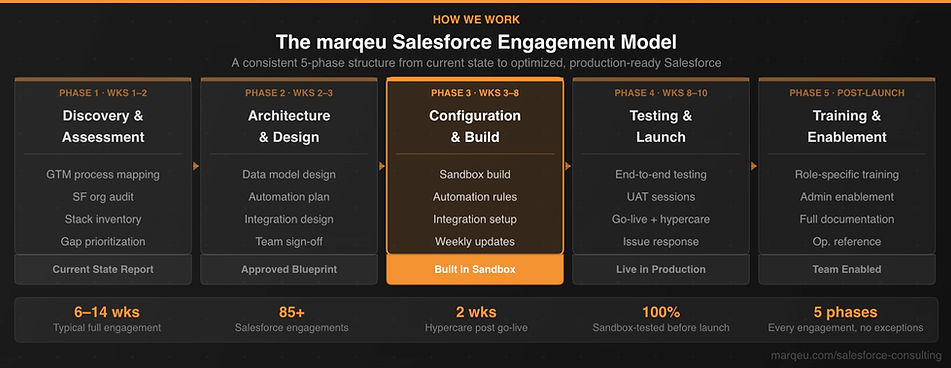
Phase 3: Configuration and Build (Weeks 3 to 8)
Configuration and build work proceeds against the approved design. We work in a sandbox environment, testing every automation rule, routing logic, and integration connection before promoting to production. We provide weekly status updates with a clear view of what is complete, what is in progress, and what is coming next.
Phase 4: Testing, Validation, and Launch (Weeks 8 to 10)
Before going live, we conduct end-to-end testing across every process flow. Lead routing, integration sync, automation rules, report accuracy, and user access are all validated. We also conduct user acceptance testing with your marketing and sales operations teams to ensure the configuration meets operational requirements. Go-live is followed by two weeks of hypercare support where marqeu consultants are available for immediate response to any issues that arise.
Phase 5: Training and Enablement
We deliver role-specific training for marketing operations, sales operations, and revenue leadership. Training covers the specific Salesforce configuration we have built, not generic platform education. We document every automation rule, integration configuration, and reporting framework so your team has a complete operational reference. We also provide training for the internal Salesforce admin who will own ongoing platform maintenance.
Salesforce CRM Integration for Marketing Automation: The Full Ecosystem Perspective
One of the most common misconceptions about Salesforce consulting is that it begins and ends with the Salesforce org. The reality for B2B marketing operations teams is that Salesforce's value is inseparable from the quality of its connections to the rest of the marketing technology stack.
Our Salesforce consulting practice encompasses the full integration ecosystem that a B2B marketing operations team depends on. We configure and maintain Salesforce integrations across the following categories.

Marketing Automation Platforms: The Salesforce connection to the MAP is the most operationally critical integration in the stack. We implement and maintain bidirectional syncs with Marketo, HubSpot, Pardot, and Eloqua, covering field mapping, campaign member management, sync error handling, and lead status management.
ABM and Intent Data Platforms: For organizations running account-based marketing programs, we integrate Salesforce with 6sense, Demandbase, and G2 to bring intent signals and account engagement data directly into the CRM and make it actionable for sales teams in their daily workflow.
Data Enrichment Tools: We implement and configure ZoomInfo, Clearbit, and similar enrichment integrations that automatically populate missing firmographic data on new leads and contacts, improving segmentation quality and lead scoring accuracy.
Business Intelligence and Analytics: We connect Salesforce to data warehousing and BI infrastructure including Snowflake, BigQuery, Tableau, Looker, and Sigma for organizations that need cross-platform analytics that goes beyond what Salesforce native reporting can support.
Sales Engagement Platforms: Outreach and Salesloft integrations with Salesforce require careful configuration to ensure activity data syncs correctly, sequence enrollment is tracked at the lead and contact level, and sales engagement data is available in marketing attribution models.
Related marqeu Services That Work Alongside Salesforce CRM Consulting
Salesforce CRM consulting does not exist in isolation. The Salesforce org you build is only as valuable as the processes and technology it supports. Here is how our Salesforce consulting practice connects to the broader set of marketing operations and analytics services we provide.
Marketing Attribution Consulting: The attribution data model we build in Salesforce directly enables the multi-touch attribution reporting our analytics practice delivers. Clean campaign member data and proper campaign-to-opportunity linkage in Salesforce is the prerequisite for trustworthy attribution analysis.

Marketing Database Management: The data quality discipline we implement in Salesforce is inseparable from broader marketing database management best practices. Deduplication, field normalization, and enrichment integration work we do in Salesforce connects directly to our database management practice.
Lead Scoring and Lead Management: Lead scoring models built in Marketo or HubSpot depend on clean, complete data in Salesforce. The field mapping and sync configuration we implement ensures that the behavioral and firmographic data feeding the scoring model is accurate and current.
Account Based Marketing: ABM programs require Salesforce to support lead-to-account matching, account-level engagement data, and territory-based routing. We build the Salesforce infrastructure that makes ABM execution and analytics operationally viable for marketing and sales teams.
Advanced Marketing Analytics: For organizations that need to connect Salesforce data to a broader analytics infrastructure, our marketing analytics consulting practice extends the Salesforce foundation into Snowflake, BigQuery, Tableau, and other platforms that support more sophisticated analysis than Salesforce native reporting allows.
Frequently Asked Questions: Salesforce CRM Consulting for B2B Marketing Operations
What is Salesforce CRM consulting and what does it include?
Salesforce CRM consulting refers to expert services that design, implement, configure, optimize, and maintain Salesforce to support your specific business processes. For B2B marketing and revenue operations teams, this includes data model design, lead routing configuration, marketing automation integration, sales process automation, reporting and dashboard development, data quality management, and ongoing administration. A Salesforce consulting firm like marqeu brings the technical expertise and strategic guidance to help your team get maximum value from the platform.
How much does Salesforce CRM consulting cost for a B2B marketing organization?
Salesforce consulting costs vary significantly based on scope. A focused optimization engagement addressing specific issues in an existing org typically ranges from $15,000 to $40,000. A full Salesforce implementation for a B2B marketing and revenue operations team typically ranges from $30,000 to $80,000 depending on integration complexity, automation scope, and data migration requirements. Ongoing managed services retainers start at $3,000 to $5,000 per month and scale based on the volume and complexity of work required. The ROI on Salesforce consulting is typically realized within the first quarter through improved pipeline visibility, reduced data management time, and higher lead-to-opportunity conversion from better routing and follow-up processes.
What makes a Salesforce implementation partner different from a Salesforce admin?
A Salesforce administrator manages day-to-day platform operations: user management, field updates, report creation, and basic automation maintenance. A Salesforce implementation partner brings strategic expertise in designing how the platform should be configured to support your specific business model, GTM motion, and technology stack. For B2B marketing operations teams, the implementation partner understands how Salesforce decisions affect marketing attribution, lead scoring, ABM execution, and revenue reporting in ways that a generalist admin typically does not. marqeu serves both roles: we design and implement the right Salesforce architecture and we provide ongoing administrative support to maintain it.
How do you handle the Salesforce and marketing automation integration?
The Salesforce-to-MAP integration is one of the most technically nuanced connections in the B2B marketing technology stack. We begin by auditing the existing integration (if one exists) or designing the target integration architecture from scratch. We configure field mapping with proper data type alignment, set up sync error monitoring and alerting, implement campaign member status management for attribution, configure lead-to-contact conversion handling, and set up permission models that ensure data updates flow correctly in both directions. We work with Marketo, HubSpot, Pardot, Eloqua, and other MAPs and have deep experience with the specific integration behaviors and failure modes of each platform.
Can you help us improve our Salesforce marketing attribution reporting?
Yes. Marketing attribution in Salesforce requires a specific data model: campaign member records need to capture touchpoints correctly, campaign-to-opportunity linkage needs to be set up properly, and the reporting framework needs to support the attribution model your organization uses. We design and implement attribution data models that support first-touch, last-touch, multi-touch, and custom attribution approaches within Salesforce, and we build the reports and dashboards that give marketing leadership a reliable view of pipeline contribution. For organizations that need attribution analytics that go beyond Salesforce's native capabilities, we connect to external BI tools and build cross-platform attribution models.
How long does a Salesforce CRM implementation take for a B2B marketing team?
A typical Salesforce implementation for a B2B marketing and revenue operations team takes 8 to 14 weeks depending on scope. Implementations with complex data migration requirements, multiple MAP integrations, or extensive custom automation can take longer. Optimization engagements addressing specific issues in an existing org typically move faster, with most completing in 4 to 8 weeks. We set realistic timelines at the engagement outset based on a thorough scope assessment and we have a strong track record of delivering on time.

Ready to Build a Salesforce Instance That Performs for Marketing
If your Salesforce instance is underperforming: generating unreliable data, creating friction between marketing and sales, failing to support the attribution and pipeline reporting your leadership needs, or simply not keeping up with the growth of your marketing operations function, we would like to help. At marqeu, we have spent more than 10 years working at the intersection of Salesforce and B2B marketing operations. We understand what a properly configured Salesforce org should look like for a marketing and revenue operations team, and we know the path from where most organizations are to where they need to be.
The right first step is a conversation. We will take 30 minutes to understand your current Salesforce state, your team structure, your GTM motion, and your biggest operational challenges. From there, we will give you a clear picture of what a marqeu engagement would involve and what results you can expect. There is no sales pressure and no commitment required.