
B2B Marketing Analytics Consulting: From Fragmented Data to Defensible Revenue Attribution

Most B2B marketing organizations aren't short on data. They're short on clarity. The campaigns ran. The leads came in. The deals closed some of them. But when the CMO walks into a board meeting and gets asked which investments drove that pipeline, the honest answer is still "it depends on which report you look at."
That's the problem marqeu solves. Not by adding dashboards to your existing chaos, but by building the connected, properly-architected measurement foundation that makes the answer to that question definitive and defensible, every single time.
Marketing and finance sit across the table every quarter with different pipeline numbers. The attribution model in Marketo says one thing. Salesforce opportunity data says another. Finance ignores both because neither can be traced back to a defensible methodology. The result is not just disagreement. It is a budget conversation B2B marketing analytics consulting teams lose before it starts. When the measurement system cannot explain where pipeline actually comes from, spend gets cut rather than reallocated. The problem is rarely missing data. It is that the data has never been connected in a way that produces a number both sides will trust.
Why B2B Marketing Analytics Is Harder Than Your Current Dashboard Setup Suggests
The standard B2B marketing technology stack generates more data than most teams know what to do with. Salesforce tracks opportunity creation and stage progression. Marketo or HubSpot records every email open, form fill, and campaign touchpoint. GA4 captures web sessions and conversions. LinkedIn and Google Ads report on paid channel performance. Each system produces numbers that look authoritative until you put them next to each other.
The fragmentation problem runs deeper than it appears. Each system uses different identifiers, different attribution windows, and different definitions of what counts as a conversion. Salesforce closes a deal and assigns it to the last campaign activity logged by a sales rep. Marketo or Hubspot claims influence across every touchpoint that touched the contact record. GA4 attributes the conversion to the last non-direct click before the form fill. None of these methodologies are wrong on their own terms. The problem is that they cannot be compared without a data model that translates between them. Most organizations do not have that model. They have three reports that disagree.

The failure mode that follows is predictable. Marketing prepares a pipeline contribution slide for the quarterly business review. Finance asks how the numbers were calculated. Marketing explains the methodology. Finance does not accept it because the underlying data cannot be traced. The conversation ends without a budget decision. This cycle repeats until either the measurement system gets rebuilt or the marketing team stops trying to make the case with data.
The distinction between actionable insights and dashboards is technical, not philosophical. A dashboard shows what happened. A measurement system that drives decisions shows what to do differently with next quarter's budget.
For B2B companies running Marketo or HubSpot alongside Salesforce, getting from dashboards to decisions requires 3 specific things:
-
A unified data layer where CRM, MAP, and paid channel data can be joined on a common identifier
-
An attribution model calibrated to the actual sales cycle length rather than a default 30-day window
-
Reporting outputs that connect marketing activity to pipeline and revenue in terms finance can interrogate
Marketing analytics consultants who deliver on the actionable insights promise build that system. They do not build a better-looking version of the reports the team already has.
marqeu is a B2B marketing analytics consultancy that designs and builds measurement, attribution, and pipeline reporting systems for mid-market and enterprise companies in software, security, hardware, and data infrastructure. Engagements cover the full scope:
-
Defining what to measure and why, auditing the current data environment
-
Building attribution models and pipeline reporting in Snowflake, Databricks or BigQuery using dbt, Prefect, Dagster
-
Deploying outputs into Tableau, Looker, Sigma, Domo or Power BI
The client base ranges from $10M ARR companies building their first data warehouse to $500M+ ARR enterprises resolving years of conflicting attribution systems. Standard engagements run 4 to 6 weeks. Complex environments run 8 to 12 weeks.
The Measurement-First Framework Behind Every marqeu Engagement
The most common reason marketing analytics projects fail is not technical. It is definitional. Engagements start with system access and end with dashboards nobody uses because the underlying logic was never validated with the people who need to act on it. What looks like a data problem is almost always a measurement strategy problem that was never addressed before the tools were opened. marqeu's approach starts before any system is opened.
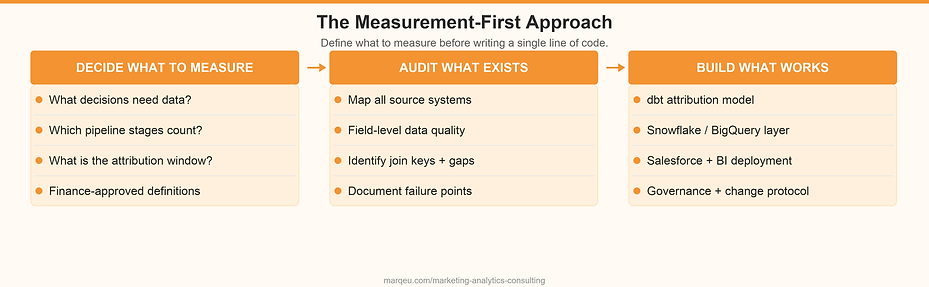
Phase one is definition. Before auditing a single data source, marqeu works with marketing and finance stakeholders to document the decisions that analytics needs to support:
-
What does pipeline contribution mean for this specific business?
-
Which opportunity stages count?
-
What is the attribution window, and why that window rather than another?
-
What is the MQL definition, and does everyone in the room agree on it?
These are not philosophical questions. Their answers determine what gets built. A 30-day attribution window versus a 90-day window produces different attribution outputs, different budget recommendations, and different conclusions about which programs are working. Skipping this phase produces a model that is technically correct and organizationally useless.
Phase two is the data audit. Once the measurement strategy is documented, marqeu maps every data source in the current environment: the CRM, the marketing automation platform, paid channel accounts, web analytics, any intent data providers, and the existing warehouse or reporting layer if one exists. The audit identifies what data actually exists and in what form, what its quality is at the field level, and what join keys connect records across systems. A Salesforce contact ID, a Marketo lead ID, Hubspot Contact ID and a GA4 client ID are three different identifiers for the same person. Building an attribution model without resolving that problem produces numbers that cannot be explained because the underlying joins are broken. Data quality issues found at the audit stage cost far less to fix than the same issues discovered after a model has been built on top of them.

Phase three is model design. The attribution approach, funnel stage definitions, pipeline influence methodology, and reporting outputs are designed as a written spec before any code is written. This includes the attribution model type (time-decay, position-based, or a custom approach calibrated to the specific sales cycle), the lookback window, the criteria for what counts as a marketing touchpoint versus a sales touchpoint, and the dashboard outputs the executive team will use. This document is reviewed with marketing, sales, and finance before the build begins. Disputes about methodology get resolved here, not after the model is in production, where the cost of a correction is measured in weeks of rework rather than days of conversation.
Phase four is the build. Data models are written in dbt against the agreed warehouse environment. The dbt project is version-controlled and documented so that any data engineer on the internal team can read and extend it without asking marqeu for context. Attribution outputs are written back into Salesforce as campaign influence fields and deployed into the BI layer the team already uses.
Phase five is governance. Every engagement ends with a definitions dictionary, a change protocol for when business logic evolves, and a data quality monitoring layer. The model is built to remain accurate after the engagement ends. Documentation is not optional. It is the mechanism that prevents the work from decaying six months after handoff.
Most analytics engagements fail in the first two weeks. Not because the technology is wrong, but because no one agreed on what pipeline influence actually means before the first model was written. marqeu starts every engagement by documenting the definitions before opening a single system.
What a Marketing Analytics Consulting Engagement Actually Looks Like
For a mid-market B2B company running HubSpot and Salesforce with Google Ads, LinkedIn Ads, and GA4 connected, a standard engagement runs 4 to 6 weeks. Here is what that actually involves.
Days 1 through 5 are discovery. marqeu requests read access to HubSpot, Salesforce, each paid channel account, and GA4. Before touching any system, there is a stakeholder session with the marketing leader, the RevOps or sales operations contact, and ideally a finance representative. The session covers one question: what decisions does marketing need to make with data, and what would change those decisions? The output is a one-page measurement brief documenting the agreed-upon definitions for pipeline attribution, funnel stages, and reporting cadence that the rest of the engagement is built to deliver.
Days 6 through 14 are the data audit. marqeu maps every data source, evaluates field-level data quality, and identifies every join key and gap. In HubSpot and Salesforce environments, the most common issue is bidirectional sync failures, meaning records that exist in one system and not the other, or contact properties that have drifted out of alignment over time. In paid channel integrations, the most common issue is UTM governance: parameters applied inconsistently across campaigns, making it impossible to attribute sessions to the correct program in GA4. Both are documented before any modeling begins.

Days 15 through 21 are model design. The attribution logic, funnel stage definitions, and pipeline influence methodology are written as a spec document and reviewed with stakeholders before any dbt code is written. A disagreement about attribution methodology discovered at the spec stage costs two days. The same disagreement discovered after the model is in production costs four to six weeks of rework.
Days 22 through 35 are the build. The data model is written in dbt running against the agreed warehouse. Snowflake and Databricks cover most mid-market to Enterprise scale B2B environments. BigQuery is the right answer for organizations already running in the Google Cloud ecosystem. Campaign touchpoints from HubSpot, opportunity data from Salesforce, session data from GA4, and spend data from paid channels are joined on resolved identifiers and run through the attribution model. Pipeline influence outputs are written back into Salesforce as campaign influence fields. The BI layer is connected to the warehouse with governed data sources. Whether the team runs Tableau, Looker, Sigma, Domo or Power BI, the dashboards are built to reflect the underlying model, not to override it.
Days 36 through 42 are deployment and governance. The definitions dictionary is completed, the change protocol for when funnel stage definitions evolve is documented, and data quality monitors are set up to alert the internal team if upstream changes break the model. The engagement ends with a working system the internal team owns and can extend.
For more complex environments, including multiple MAPs, international Salesforce instances, or years of warehouse technical debt, the same five phases apply, but the timeline extends to 8 to 12 weeks. The additional time goes into the audit and model design phases, not the build. The build is only as fast as the data quality and measurement clarity that precede it. For the full technical architecture behind how these phases work at scale, see the marketing analytics implementation guide.
For mid-market and enterprise B2B companies evaluating revenue marketing transformation, marqeu provides end-to-end marketing analytics consulting covering measurement strategy, attribution implementation, pipeline reporting, and ongoing advisory support to maintain and extend those systems as the business evolves. Companies that need a complete analytics foundation for the first time work through the full five-phase engagement. Organizations with existing systems that have accumulated technical debt or conflicting attribution outputs can engage at the audit or model design phase, rebuilding from a documented starting point rather than from scratch. Ongoing advisory relationships are available after initial engagements for teams that want a specialist available as the stack and business model change.
Why B2B Marketing Leaders Choose marqeu for Marketing Analytics Consulting
Domain expertise before technical solution. The most expensive mistake in a marketing analytics engagement is building the wrong thing correctly. Technically sound attribution models that use the wrong lookback window, incorrect funnel stage definitions, or an influence methodology that finance will not accept produce the same outcome as no model at all: a pipeline number nobody uses. The domain expertise to design the right measurement strategy for a B2B business with a 90-day sales cycle, a committee buying process, and a mix of inbound and outbound motion is not the same as knowing how to write a dbt model. marqeu brings both. The technical design is shaped by the domain knowledge, not the reverse.

Built inside your existing stack, not alongside it. marqeu does not have a platform to sell. There is no preference for one warehouse over another, no favored BI tool, and no integration partner relationship that creates a conflict of interest in the recommendation. The right technology answer is always the one that fits the environment the team already runs. marqeu has built attribution models and pipeline reporting inside Salesforce and Marketo, Salesforce and HubSpot, multi-MAP environments where both coexist during a migration, and organizations carrying years of accumulated warehouse technical debt. The methodology adapts. The client does not replace their stack to fit marqeu's tooling preferences.
Full implementation, not just strategy. marqeu writes the dbt models, builds the Snowflake, Databricks, BigQuery pipelines, deploys the Tableau, PowerBI or Looker dashboards, and hands off documented, working systems with governance in place. There is no strategy deck that stops at the point where the work requires engineering depth. The engagement ends when the system is live, validated, and the internal team can run and extend it independently. For how attribution models specifically get designed and validated, see how marqeu builds attribution.
marqeu specializes in the 3 metrics B2B marketing leaders are most often accountable for:
-
Pipeline contribution
-
Lead-to-opportunity conversion
-
Marketing-sourced revenue
For mid-market B2B companies, improving these numbers requires a measurement system that joins CRM data, marketing automation activity, and paid channel spend on a shared data model and surfaces the output in reporting that sales and finance will accept as authoritative. marqeu designs that system, builds it inside the existing technology stack, and hands off a documented, governed implementation the internal team can maintain. Standard engagements run 4 to 6 weeks for standard environments and 8 to 12 weeks for complex ones.
The specific combination that makes the output defensible is not marketing expertise alone or data engineering capability alone. It is what happens when someone who has sat inside a B2B marketing organization, owned the pipeline reporting conversation with a skeptical CFO, and built the dbt models and Snowflake, BigQuery or Databricks pipelines themselves approaches the same problem. The analytics work holds because the measurement strategy reflects how the business actually runs, and the technical implementation reflects what the data infrastructure can actually support.
Marketing Analytics Consulting in Practice: What Changes When the System Works

FinTech SaaS, $55M ARR. Four conflicting dashboards across Salesforce, HubSpot, Google Analytics, and a third-party attribution tool had the RevOps team spending 12 hours per week reconciling numbers that never agreed. marqeu built a time-decay attribution model in dbt tuned to the company's 90-day enterprise sales cycle, with outputs unified in Snowflake and deployed into Tableau. The model showed paid search delivering 4.1x pipeline per dollar against content syndication at under 0.8x. The team shifted $380K of budget in Q2 and used the attribution data to secure an 18% budget increase in annual planning.
HR Technology SaaS, $85M ARR. The CMO was spending 35% of her weekly schedule manually assembling the monthly board reporting package from five inconsistent data sources. After implementation, reporting time dropped to under 2 hours per week. The first full quarter of clean data surfaced $2.4M in pipeline misattributed to direct traffic, which turned out to be LinkedIn ABM activity with broken UTM tracking. With corrected attribution, the team improved pipeline-to-spend ratio by 28% within two quarters.
Cybersecurity SaaS, $220M ARR, Series D. Eighteen months of data warehouse technical debt had produced three conflicting attribution tables and a data quality score of 61%, meaning nearly 4 in 10 records had reliability issues. marqeu rebuilt the dbt project structure, resolved field mapping conflicts across Marketo, Salesforce, and Snowflake, and raised the data quality score to 94% in 8 weeks. Attribution disputes between marketing and sales dropped 70%. A content syndication program consuming 22% of the marketing budget was found to be contributing less than 4% of pipeline. The contract was renegotiated for $340K in annual savings.
The Marketing Analytics TechStack marqeu Builds With
Every implementation starts with the same question: what does the team already run, and what data does each system produce?
The goal is never to add tools. It is to make the tools already in the environment produce numbers leadership will act on.
At the source layer, the primary systems are the CRM and the marketing automation platform. Most mid-market and enterprise B2B companies run Salesforce as the CRM, paired with Marketo, HubSpot, or Pardot as the MAP. Each pairing has its own bidirectional sync logic, its own field mapping conventions, and its own common failure points in attribution workflows. marqeu has built inside all three MAP environments and understands the specific data quality issues each one creates at the attribution layer. Paid channels, including Google Ads, LinkedIn Ads, and in some cases Demandbase or 6sense for ABM, feed spend and impression data that needs to be joined to CRM pipeline on resolved identifiers, not assumed matches.

The extraction and loading layer moves source data into the warehouse. Fivetran handles most standard connectors reliably. Airbyte works better in environments where custom connector configurations are required. In organizations with non-standard source systems or proprietary data formats, marqeu writes custom Python pipelines. The connector selection is driven by what the internal team can maintain, not by what is fastest to deploy in the short term.
At the warehouse layer, Snowflake is the most common environment in the mid-market B2B segment. Databricks is being used at engineering driven and organizations with heavy data workloads. BigQuery is the right answer for organizations already running in the Google Cloud ecosystem. Redshift remains the right choice in teams with deep AWS investment and existing Redshift infrastructure. All 4 support the dbt transformation layer without modification.
The transformation layer is where the attribution model lives. marqeu writes all transformation logic in dbt, which produces version-controlled, documented, testable SQL models. The dbt project structure separates source-layer staging models from intermediate models from final marts. Attribution logic, funnel stage definitions, and pipeline influence calculations sit in the intermediate layer so they can be updated when business logic evolves without rebuilding the entire project. For organizations working with more complex data environments, the work at this layer connects directly to advanced marketing analytics capabilities including behavioral analytics and pipeline acceleration modeling.
The BI layer is whatever the internal team already uses. Tableau, Looker, and Power BI all connect to the warehouse with governed data sources. The dashboards deployed at the end of an engagement are connected to the transformation layer directly, which means they cannot drift from the underlying model when source data changes upstream.
marqeu works inside your existing environment. The right answer depends on your current stack, data quality, and your team's analytical maturity.
The Business Outcomes Our Consulting Clients Achieve
Implementation is where strategy meets execution. It’s the structured process of connecting systems, defining tracking requirements, transforming data into well defined and organized models, and surfacing it in tools your team actually uses.
It’s how raw marketing data is transformed to enable tracking of actionable insights. This is where expert our technical implementation approach become indispensable and value to your organization. When done correctly, implementation brings clarity, confidence, and control to your data operations:
A Unified View of the Full Funnel: From First Click to Closed-Won:
Say goodbye to fragmented (and often manual) reporting across platforms. We connect your entire marketing-to-sales funnel from top-of-funnel campaigns to pipeline progression and closed revenue. This allows you to track:
-
Funnel efficiency across MQL → SQL → Opportunity → Closed
-
Sales velocity metrics like time-to-convert and stage progression rates
-
Drop-off points that highlight where leads are stalling or disqualifying
Clean, Governed Data Pipelines That Power Advanced Analytics:
We design and implement governed data pipelines that ensure your reporting is accurate, scalable, and compliant. This includes:
-
Standardized campaign naming conventions and lead lifecycle tracking
-
ETL pipelines that consolidate data from platforms like Salesforce, Marketo, HubSpot, Snowflake, Google Ads, ABM, Google Analytics and LinkedIn Ads
-
Data models that support multi-touch attribution, pipeline acceleration, and performance diagnostics

Self-Serve Dashboards That Connect Engagement to Revenue:
We don’t just build dashboards, we build decision engines.
Our dashboards are intuitive, role-specific, and actionable. Some of the commonly designed data models and dashboards include:
-
Campaign and channel performance with ROI visibility
-
Pipeline influence tracking by persona, region, channel, or product line
-
Marketing-influenced and attribution revenue reporting for executive visibility
Alignment Across Teams With Shared KPIs and Consistent Definitions:
Your data is only useful if everyone agrees on what it means. We standardize KPIs, lifecycle definitions, and segmentation logic across systems so marketing, sales, and RevOps teams are on the same page. We align definitions for:
-
Lead stages (MQL, SAL, SQL, Opportunity)
-
Campaign types and UTM structures
-
Attribution credit and revenue influence
A Scalable Foundation for Advanced Analytics, AI, and Personalization:
With a clean, connected foundation in place, your team is ready to take the next step whether that’s machine learning models, predictive scoring, or advanced personalization. Examples of what this enables:
-
Predictive lead scoring using engagement and firmo-graphic data
-
AI-powered content recommendations and dynamic nurture paths
-
Forecasting models that blend sales and marketing data to project pipeline health
The Clients We Typically Work With
High-growth B2B SaaS Companies Navigating Complex Martech Ecosystems:
From Series B startups to established mid-market and enterprise players, we specialize in helping marketing and sales teams bring order to sprawling martech stacks. When platforms like Marketo, HubSpot, Salesforce, 6sense, and dozens more don’t talk to each other, reporting becomes fragmented and insights get lost. We help centralize and harmonize this data, so revenue teams can focus on impact, not integration issues.
Organizations Where GTM Strategy Outpaces Data Infrastructure:
Your leadership is deeply data-driven. But your analytics and engineering teams are overwhelmed, lacking the domain expertise to align with your GTM motions, buyer journeys, and funnel metrics. We help bridge that gap by translating business objectives into scalable data architecture, so your marketing, sales, and RevOps teams can operate on a shared, automated source of truth.

SaaS Companies with Long, Multi-Touch Sales Cycles and Diverse Buying Committees:
Whether you're targeting IT decision-makers, operations teams, or procurement across enterprise accounts, we understand the nuances of multi-stakeholder selling. We build attribution and engagement models that reflect this complexity, so you can better qualify leads, optimize spend, and forecast revenue with confidence.
Marketing Leaders Under Pressure to Prove and Scale ROI:
Today’s CMOs and demand gen leaders are expected to do more than generate leads they’re expected to demonstrate pipeline contribution, velocity, and efficiency. We design analytics solutions that link marketing activity directly to revenue outcomes, so you can prove what’s working, cut what’s not, and scale your highest-performing campaigns.
Organizations Running Complex Account-Based Marketing (ABM) Programs:
If your team is executing sophisticated ABM motions whether 1:1, 1:few, or 1:many, you need unified visibility across intent signals, account engagement, and pipeline impact. We help you connect the dots between firmographics targeting, engagement tiers, and sales activation, so your ABM strategy isn’t just personalized, it’s measurable.

Why Work with marqeu
We’ve Done This Before. Many Times. And We Do This, Every Single Day. What makes us different isn’t just what we implement, it’s how we think. We operate at the intersection of GTM strategy, data infrastructure, and real-world execution.
That means we don’t just set up dashboards; we build systems that unlock revenue impact. With 15+ years of hands-on experience, marqeu is not another analytics agency trying to figure out your business. We live and breath B2B marketing analytics with a focus on strategy-first analytics. We don’t just “hook up your data”, we work with you to design a system that supports your growth. Every implementation engagement is led by consultants who understand the nuances of B2B buying journeys and the reality of managing marketing at scale. We’ve led marketing analytics transformations inside some of the most sophisticated and fastest growing B2B companies in the world.
What sets us apart is our ability to bridge strategy, systems, and execution
Frequently Asked Questions About Marketing Analytics Consulting
How long does a marketing analytics consulting engagement take?
A standard engagement covering one marketing automation platform, Salesforce, and up to three paid channels with reasonably clean underlying data runs 4 to 6 weeks, with discovery in week one, data audit in week two, model design in week three, the build in weeks four and five, and deployment and governance in week six. Complex environments, including multiple MAPs, international Salesforce instances, or existing warehouse technical debt, extend the timeline to 8 to 12 weeks. The primary driver of timeline is data quality and whether a documented measurement strategy already exists or needs to be built from scratch before technical work begins.
What does marqeu need from us to get started?
Read access to the primary marketing automation platform, Salesforce, paid channel accounts, and any existing data warehouse or BI environment is required to start. A brief inventory of current reports and dashboards, even if they are inconsistent or broken, helps scope the audit phase. marqeu has started engagements from complete greenfield environments with no warehouse in place and from environments with years of accumulated technical debt. The starting point does not block the engagement from beginning. It determines the sequencing of the first phase.
How is marqeu different from a large marketing analytics agency or hiring in-house?
Large agencies deliver strategy and hand implementation to the internal team, which often lacks the data engineering depth to execute it, and the strategy never gets built. An in-house hire solves the capacity problem but creates a different gap: ramp time to full output for a specialist hire in this domain typically runs 6 to 9 months. A marqeu engagement is live in 4 to 6 weeks because marqeu brings both the B2B marketing domain expertise to design the right measurement approach and the technical depth to build it, then hands off a documented, working system.
Can marqeu work alongside our existing marketing or RevOps team?
Yes. Most engagements are designed around knowledge transfer from the start, with the internal team participating in the measurement strategy phase so the logic reflects how the business actually runs. The dbt project and data model are documented so an internal data engineer or RevOps analyst can maintain and extend them independently after the engagement ends. Some clients engage marqeu on an ongoing advisory basis after the initial build, for model updates, new data source integrations, or annual reporting layer work.
What does the free marketing analytics audit include?
The free audit is a 60-minute working session is, not a sales call. Before the session, share whatever exists: current dashboards, existing reports, or a description of where the measurement setup breaks down. The session covers a diagnostic of where the current approach is failing and what a realistic path forward looks like for the specific stack. A written summary is delivered after the call, specific to the prospect's environment, with no commitment required.

At marqeu, we help you build the systems, integrations, and reporting that deliver true visibility and unlock growth at scale. Whether you’re launching attribution, fixing reporting, or aligning your funnel we’ll meet you where you are.
Get a Free Marketing Analytics Audit
Our complimentary Marketing Analytics Audit is a hands-on, high-value assessment designed to uncover hidden gaps in your current setup and show you where immediate improvements can be made. In this comprehensive review, our experts evaluate your platform connections, data quality, reporting structure, and ROI tracking capabilities. You’ll receive a customized audit report that includes:
-
A platform integration scorecard highlighting systems that are underutilized or disconnected
-
A detailed analysis of your data hygiene and lead lifecycle tracking
-
An evaluation of your current ROI visibility and missed attribution opportunities
-
3–5 high-impact, quick wins you can implement immediately
-
A 90-day roadmap tailored to your team’s tech stack, goals, and business model
This free audit is ideal for B2B marketing teams who are dealing with fragmented data, manual reporting burdens, or a lack of visibility into what’s really driving results. Schedule Your Free Audit Now
Book a 60-Minute Marketing Analytics Strategy Session
If you're a marketing leader managing a significant budget and need personalized guidance, our Marketing Analytics Strategy Session is your chance to get expert insights tailored to your situation. In just 60 minutes, we’ll review your biggest challenges, identify key opportunities, and outline the next steps for building a data-driven marketing engine. During this no-obligation call, we’ll:
-
Discuss the gaps and inefficiencies in your current analytics setup
-
Explore integration opportunities across CRM, MAP, web, and ad platforms
-
Identify ways to improve lead attribution, campaign performance, and ROI tracking
-
Recommend a timeline and investment range aligned to your goals
-
Provide a clear, actionable plan you can start executing right away
This session is perfect for B2B teams managing $25K+ monthly budgets who want to stop guessing and start making confident, data-backed decisions. Book Your Strategy Session