
B2B Segmentation Software: A Practitioner’s Guide to Building the Right Segmentation Architecture


B2B Segmentation Software: A Practitioner’s Guide to Building the Right Segmentation Architecture powered by Modern Marketing Analytics
You are sitting in a pipeline review and the VP of Sales turns to the marketing team and says: “We got 2,400 leads from last quarter’s campaigns and my team could only use 300 of them. The rest were garbage.” The problem is not lead volume. It is not even lead quality in the way most teams frame it. The problem is that the campaigns that generated those 2,400 leads were built on flat, one-dimensional audience segments. Everyone in the target industry and job level got the same message, the same offer, the same follow-up sequence. The segmentation behind the campaign was a demographic filter, not a strategic capability. This is the reality across the majority of B2B marketing organizations we work with as part of our marketing analytics consulting engagements. And when these teams start looking for answers,
many of them begin with the same question: “What B2B segmentation software should we buy?” It is a reasonable question. But it is often the wrong first question.
The answer to better segmentation in B2B is not always another tool. In many cases, the data you need is already sitting across your marketing automation platform, your CRM, your web analytics, and your intent data sources.
What is missing is the architecture that connects those systems, the analytics layer that makes the data queryable, and the consulting expertise to design segments that actually move pipeline.
This guide is written from the practitioner’s perspective. At marqeu, we have spent over 15 years consulting with B2B organizations ranging from early-stage startups to some of the largest enterprise technology companies. Segmentation architecture is at the heart of every marketing consulting engagement. This is not a listicle of tools. It is a comprehensive guide to understanding what B2B segmentation software actually does, how the different categories work, when you need new tooling versus better implementation of what you already have, and how to architect a segmentation capability that drives measurable pipeline impact.
What B2B Segmentation Software Actually Means in Practice
Before evaluating any specific platform, it helps to be precise about what “B2B segmentation software” actually encompasses. The term gets used loosely across the industry, covering everything from a filter inside your marketing automation platform to a full enterprise data enrichment suite. That ambiguity is part of the problem. Marketing leaders end up buying tools that are either two tiers above or two tiers below what their organization actually needs.
In practice, B2B segmentation software refers to any platform or capability that helps marketing teams divide their database into targeted audience groups for campaigns, nurture programs, and sales follow-up. But the range of how that gets done is enormous.
At one end of the spectrum, you have the native segmentation features inside marketing automation platforms like Marketo and HubSpot. Smart lists, active lists, and database filters that let marketers build audience segments based on fields and activity data that live inside that platform. For basic campaign execution, these are table stakes and most teams are already using them.
At the other end, you have enterprise-grade account-based marketing platforms like 6sense and Demandbase that combine data enrichment, intent signals, predictive scoring, and advertising orchestration into a single platform. These carry price tags of $50,000 to $150,000 annually and require significant implementation effort to deliver value.
Between those extremes sits a wide middle ground of data enrichment platforms (Clearbit, now Breeze Intelligence through HubSpot; ZoomInfo; Cognism), customer data platforms or CDPs (Segment, mParticle, Tealium), and specialized segmentation tools that solve specific pieces of the puzzle.
The critical question is not which tool is the best. It is which capability gap is actually limiting your segmentation today and what is the most efficient way to close it.
In our experience across numerous B2B implementations spanning startups through Fortune 500 enterprises, we find that the majority of organizations in the 10 to 500 employee range already own 70 to 80% of the data they need for advanced segmentation. It is sitting in Salesforce, in Marketo or HubSpot, in their web analytics platform, and in whatever intent data provider they have invested in.
The challenge is not data scarcity. It is data accessibility. The data lives in silos. Each platform knows a piece of the story. Nobody has assembled the complete picture.
The 3 Categories of B2B Segmentation Software
When you cut through the marketing jargon and vendor positioning, the B2B segmentation software market splits into three functional categories. Understanding which category solves your specific problem is the first step to making the right investment.
1. Data Enrichment Platforms
These platforms fill gaps in your existing records. You have email addresses and company names; they add firmographics, technographics, and intent signals. Clearbit (now Breeze Intelligence through HubSpot), ZoomInfo, and Cognism are the established players here.
Data enrichment solves a specific problem: you cannot segment on data you do not have. If your database has 50,000 contacts but only 40 percent have complete industry and company size fields, your segmentation options are limited from the start. Enrichment platforms close that gap by appending firmographic data (industry, employee count, revenue range, technology stack) to your existing records.
Where enrichment gets interesting for segmentation is when it extends beyond basic firmographics into intent data. Platforms like Bombora and TechTarget track what topics and products a prospect’s company is researching across the web. When that intent data gets appended to your database records, it adds a dimension that most marketing automation platforms cannot generate natively.
At marqeu, we frequently work with organizations that have already invested in enrichment tools but are not seeing the segmentation impact they expected. The typical root cause is that the enriched data is sitting in the platform but has not been connected to the that makes it actionable for campaigns. The data arrives, but nobody has built the data pipelines, the transformation logic, or the automation to turn it into campaign-ready micro-segments.

2. Customer Data Platforms (CDPs)
CDPs unify behavioral data across touchpoints and create segments based on actions, not just attributes. Segment, mParticle, and Tealium anchor this category.
The core value of a CDP for B2B segmentation is identity resolution. When a prospect visits your website, downloads a whitepaper, attends a webinar, and then gets a sales call, those interactions are often tracked in four different systems. A CDP stitches them together into a single unified profile, giving you a complete behavioral picture of each contact.
For organizations running multiple products or operating across multiple regions, CDPs can look attractive on paper and eBooks because they position themselves as solving the fragmentation problem at the data layer. But they come with significant implementation complexity and cost. The biggest red flag for CDPs is that they come as black-boxes with limited to no customization unless you can allocate a decent amount of budget for customizations. In our consulting work, we find that B2B organizations rarely need a standalone CDP.
Much advanced and customized behavioral unification can typically be achieved through a well-architected data warehouse (Snowflake or BigQuery) with integration tools like Fivetran and dbt pulling data from each source system and transforming it through modular SQL models before it reaches the analytics layer.
3. Account-Based Marketing (ABM) Platforms
ABM platforms combine enrichment, intent data, and advertising orchestration for targeted account engagement. 6sense and Demandbase dominate enterprise ABM.
These platforms are designed for organizations that have moved beyond lead-level marketing and are running coordinated campaigns against specific target accounts. The segmentation capability in an ABM platform is account-centric rather than contact-centric: you are segmenting accounts based on fit scores, intent signals, and engagement patterns, then targeting the buying committees within those accounts.
The price point and complexity of these platforms means they are most appropriate for organizations with established and the internal resources to operationalize them. For organizations still building their foundational segmentation capability, an ABM platform is often premature. The intent data and account scoring that ABM platforms provide can be replicated at a fraction of the cost through a combination of enrichment tools, your existing CRM data, and a purpose-built analytics layer.
The Hidden Fourth Option: Building a Segmentation Engine on Your Existing Stack
Here is the part that most software comparison guides leave out, because it does not generate affiliate commissions or vendor partnerships.
For the majority of B2B organizations, the most impactful segmentation investment is not a new tool. It is building a on top of the platforms you already own.
The architecture is built on proven data engineering patterns that marqeu has refined over 15+ years of implementing custom marketing analytics solutions for B2B marketing organizations.

All the data that exists across your MarTech stack, your marketing automation platform, your CRM, your sales engagement tools, your web analytics, your intent data provider gets extracted through managed connectors (Fivetran, Stitch, or custom-built API integrations) and loaded into a centralized cloud data warehouse, typically Snowflake or BigQuery. From there, a transformation layer built in dbt (data build tool) applies business logic: normalizing fields, resolving identities, computing engagement scores, and building the dimensional models that power segmentation. On top of that warehouse, a visual analytics layer in Tableau, Looker, PowerBI, or Sigma gives marketing analysts the ability to construct multi-dimensional audience segments without writing SQL.
The data pipeline architecture follows a standard ELT (Extract, Load, Transform) pattern. Source connectors pull raw data from each platform on an automated schedule typically daily or near real-time depending on the source. The raw data lands in staging schemas within the warehouse. dbt models then transform and join this data into analytics-ready tables: a unified contact model, an account model enriched with pipeline and intent data, an engagement model that rolls up activity across channels, and a segmentation model that pre-computes the dimensions marketers need for campaign targeting.

The result is a segmentation capability that goes far beyond what any single platform natively offers.
Instead of being limited to the fields and activity data inside Marketo or HubSpot, your marketing team can build segments that cross-hatch data from every source simultaneously: demographic and firmo-graphic data, campaign engagement history, pipeline and account context from Salesforce, and real-time intent and web engagement signals.
The difference between a smart list and a segmentation engine is the difference between looking at someone’s LinkedIn profile and reading their full dossier. One tells you their job title. The other tells you everything.
This is exactly what we build at marqeu with our advanced marketing analytics consulting practice.
We do not sell software. We architect and implement the data infrastructure, integration pipelines, transformation logic, and analytics capability that turns your existing MarTech stack into a segmentation powerhouse. The tools stay the same. The architecture changes everything.
What Features Actually Matter When Evaluating B2B Segmentation Software
If you do determine that your organization needs new segmentation tooling, here are the capabilities that actually matter for B2B use cases not the features that look impressive in a demo but rarely get used in practice.
Multi-Dimensional Segmentation
The ability to build segments that combine firmo graphic data, behavioral data, pipeline context, and intent signals simultaneously. If a tool only lets you filter on one dimension at a time or requires you to export and merge lists manually, it is not solving the real problem.
Native Integration With Your Existing Stack
Does it connect natively to your CRM and marketing automation platform? If the tool requires manual data imports and exports to work with Salesforce and Marketo, the operational overhead will kill adoption within 90 days. The integration should be bidirectional: segments built in the tool should push directly back into your marketing automation platform for campaign execution.

Real-Time or Near Real-Time Data
Segmentation based on data that is 48 hours old is segmentation based on yesterday’s reality. For intent-driven and behavioral segments, the data needs to refresh at minimum daily and ideally in near real-time. Ask vendors specifically about sync frequency, pipeline latency, and whether incremental or full loads are supported.
Account-Level and Contact-Level Segmentation
B2B buying involves committees, not individuals. Your segmentation capability needs to work at both the account level (which accounts are showing buying signals) and the contact level (which individuals at those accounts are engaged). Tools that only support one level are incomplete for B2B.
Visual Segmentation Builder
Marketing analysts and demand generation managers should be able to build segments without writing SQL queries or filing tickets with a data engineering team. An intuitive visual interface that lets marketers explore and segment the data directly is critical for adoption and speed.
Segment Activation and Reverse ETL
Building a segment is only half the job. The segment needs to flow back into your campaign execution platforms. Look for native sync capabilities with your marketing automation platform, your CRM, and your ad platforms. This is where reverse ETL tools like Census and Hightouch become essential they close the loop between the warehouse where segments are built and the operational platforms where campaigns are executed. Without this activation layer, your segmentation engine is a reporting tool, not a campaign tool.

When Teams Buy Software They Do Not Need: The Over-Tooled Trap
One of the most common patterns we encounter during our marketing analytics consulting engagements is what we call the “over-tooled, under-architected” organization. This is the B2B company that has invested $80,000 to $120,000 annually across multiple segmentation and data platforms, but their marketing team is still building basic smart lists in Marketo for every campaign.
A mid-market cybersecurity SaaS company we worked with had this exact problem. They had Clearbit for enrichment, Bombora for intent data, 6sense for account scoring, plus their core stack of Marketo and Salesforce. Total annual investment in segmentation-adjacent tooling exceeded $110,000.

The reality on the ground: their demand generation manager was pulling static lists from Marketo filtered by job title and industry for every webinar and email campaign. None of the enrichment data from Clearbit was being used in segment construction. The Bombora intent data was arriving into Salesforce but nobody had built the logic to incorporate it into campaign targeting. The 6sense account scores existed in a dashboard that the team checked occasionally but never operationalized.
The problem was not the tools. Every tool was working as advertised. The problem was that no one had built the integration architecture, the data models, or the segmentation workflows to make those tools work together as a system.
Over a 5-week engagement, our team built the connective tissue:
We stood up Fivetran connectors to extract data from Salesforce, Marketo, and Clearbit into a Snowflake data warehouse.
We authored dbt transformation models that normalized contact records, joined enrichment data to the unified profile, and computed engagement scores across channels.
We built a Looker-based segmentation interface on top of the transformed data that gave the marketing team the ability to construct multi-dimensional segments combining firmographic fit, engagement history, intent signals, and pipeline context.
We implemented Hightouch as the reverse ETL layer to push those warehouse-built segments back into Marketo for campaign activation.
Within 6 months, the team’s campaign-to-opportunity conversion rate improved by 34%. Their cost per qualified opportunity dropped by 28%. And they ended up canceling two of their four segmentation tools because the data warehouse architecture made them redundant. Net savings: $45,000 annually after the implementation investment.
The tools were not the problem. The architecture was. Once the segmentation engine was in place, fewer tools delivered significantly better results.
When You Actually Do Need New B2B Segmentation Software
We are not anti-software. There are clear situations where adding a new tool is the right move. The key is knowing which gap you are filling and whether the tool addresses a genuine capability gap or a symptom of an architecture problem.

You need data enrichment tooling when: your database has less than 60% completeness on the firmographic fields that matter for segmentation (industry, company size, revenue range, technology stack). You cannot segment on data that does not exist, and no amount of architectural work can create data points that were never captured. In this scenario, platforms like ZoomInfo or Clearbit are the right first investment. Budget $20,000 to $40,000 annually.
You need a CDP when: almost never unless you have a lot of marketing budget that you are free to throw around on tech stack. If you are any regular B2B company with a unified modern MarTech stack, a data warehouse with Fivetran integration and dbt identity resolution models typically achieves the same result in the form of a competely customized solution at a fraction of the cost and time.
You need an ABM platform when: you have an established ABM program with dedicated resources, you have more than 500 target accounts, and you need coordinated advertising plus sales engagement orchestration across those accounts. If you are running ABM Lite with under 200 accounts, the scoring and intent data capabilities can be built through your existing stack with consulting implementation.
You need a data warehouse and BI layer when: you have good data across multiple systems but no way to query it together. This is the most common gap we see in B2B organizations with 10 to 500 employees. Snowflake or BigQuery as the warehouse, Fivetran for extraction, dbt for transformation, and Looker or Tableau for the segmentation interface.
This is the “segmentation engine” approach, and it typically delivers the highest ROI because it multiplies the value of every other tool in the stack.
Getting the Sequence Right: A Data Platform Company’s Journey
A Series B data infrastructure company came to us after their marketing team had been running campaigns for 18 months with disappointing pipeline contribution. Their was a significant issue: only 35% of records had complete firmographic data, engagement tracking was inconsistent, and their Salesforce instance had accumulated three years of unscrubbed data from multiple sources.
Their initial instinct was to buy an ABM platform to “fix segmentation.” We advised them to pump the brakes. The sequence we recommended and implemented over a 6-week engagement was deliberately ordered:

Database normalization and cleanup first (Week 1–2). We standardized industry, job function, job level, company size, and geography fields across their entire Marketo and Salesforce database using a combination of SQL-based normalization scripts and Marketo batch campaigns for ongoing enforcement.
Data enrichment second (Week 2–3, overlapping). With clean, standardized fields in place, we implemented ZoomInfo to fill the gaps bringing database completeness from 35 percent to 82 percent on critical segmentation fields. We configured the enrichment API to respect existing standardized values rather than overwriting them.
Data warehouse and segmentation interface third (Week 3–5). We stood up Snowflake with Fivetran connectors pulling from Salesforce, Marketo, Google Analytics, and ZoomInfo. We authored dbt models that built unified contact profiles, account-level rollups, and engagement scoring tables. We then built a Looker-based segmentation dashboard on top of this transformed data that gave the marketing team multi-dimensional segment building capability.
Segment activation last (Week 5–6). We implemented Census as a reverse ETL layer to push warehouse-built segments back into Marketo and Salesforce for campaign execution, with automated syncs running daily.
The results told the story:
Within 90 days of the segmentation engine going live, their webinar registration rates improved by 22 percent.
Email engagement rates increased by 18 percent.
Campaign-to-SQL conversion rate doubled from 4 percent to 8 percent because the segments were now based on multi-dimensional data rather than just job title and industry.
Six months later, they did invest in an ABM platform but by then they had the data foundation and analytics infrastructure to actually operationalize it. The ABM tool was additive, not foundational.
A Framework for Deciding: Software Purchase vs. Architecture Investment
Based on our work across numerous B2B organizations from Series A startups building their first analytics infrastructure to publicly traded enterprises redesigning their entire MarTech data architecture we have developed a simple diagnostic framework that helps marketing leaders determine whether they need new segmentation software or better architecture for their existing tools.
Ask yourself these 5 questions:
What percentage of your CRM records have complete firmographic data? If it is below 60%, start with enrichment before anything else.
Can you track individual behavior across your website, email, and product? If not, you have a data integration problem, not a segmentation software problem.
Can your marketing team build a segment today that combines firmographic fit, engagement history, pipeline context, and intent signals? If not, the bottleneck is likely architecture, not tooling.
How many data sources feed your customer view? If the answer is more than three, and they are not connected, a data warehouse integration should come before any new segmentation tool.
When a marketing analyst wants to build a segment for a campaign, how long does it take? If the answer is days (because they need to pull data from multiple systems, merge it in spreadsheets, and upload it back), the problem is architecture.
If your answers point to architecture problems rather than missing data, the highest-ROI investment is building the that connects your existing tools, not adding another platform to the stack.
Why Marketing Automation Segmentation Hits a Ceiling
The smart list in Marketo or the active list in HubSpot is genuinely useful for operational campaign execution. It lets marketers filter a database based on fields and activity data that live inside the platform. For straightforward campaigns, this is table stakes.
But the moment you want to bring in data that lives outside the marketing automation platform opportunity data from Salesforce, account-level revenue from your finance systems, web visit patterns from your analytics platform, intent signals from a third-party provider the smart list hits a wall. It simply does not have access to those data sources.

This is the ceiling that most B2B marketing teams hit somewhere between 100 and 500 employees. They have outgrown their marketing automation platform’s native segmentation capability, but they have not yet built the data infrastructure that enables the next level.
The symptoms are predictable: campaign targeting feels one-dimensional, engagement rates plateau, and the sales team complains about lead quality because the segments are too broad. Marketing leaders often interpret these symptoms as needing better software. In reality, they need better architecture specifically, a data pipeline that extracts data from each source system, transforms it into a unified analytical model, and exposes it through a segmentation interface that marketers can query directly.
Through our marketing analytics engagements, we solve this by building the bridge between what the marketing automation platform can see and what the full data warehouse holds. The marketing automation platform stays as the campaign execution engine. We add the data integration and analytics layer on top so marketing teams get dramatically richer segmentation capability while continuing to use the tools they are already invested in.
Segmentation Architecture in Practice: A Networking Hardware Company
A mid-market networking hardware company with approximately 300 employees came to us with a classic problem: their were declining quarter over quarter, and the marketing leadership team believed their segmentation was the bottleneck.
Their existing setup: Marketo Enterprise, Salesforce, Google Analytics, and a Bombora intent data subscription. Total annual MarTech spend well over six figures. Their marketing operations analyst was building campaign segments in Marketo using smart lists filtered by industry, job title, and geography. Intent data from Bombora was flowing into Salesforce account records but was not being used in any campaign targeting.
The diagnostic was clear. They had 4 different data sources that each knew a piece of the prospect story, but no system that assembled the complete picture. A director-level contact in their database might simultaneously be at an account showing high intent signals for network security solutions, have attended three webinars in the past 90 days, and be at an account with a closed-lost opportunity from the previous quarter. Each of those data points lived in a different system. No single tool could see all four dimensions at once.
We built a segmentation architecture over a 5-week engagement that unified all four data sources into Snowflake:
We configured Fivetran connectors for each source
Authored dbt transformation models that created unified contact profiles with engagement scoring and intent signal rollups
Built a Tableau interface that let the marketing team query across all dimensions simultaneously.
Hightouch handled the reverse ETL layer, pushing warehouse-built segments back into Marketo for campaign activation on an automated daily schedule.
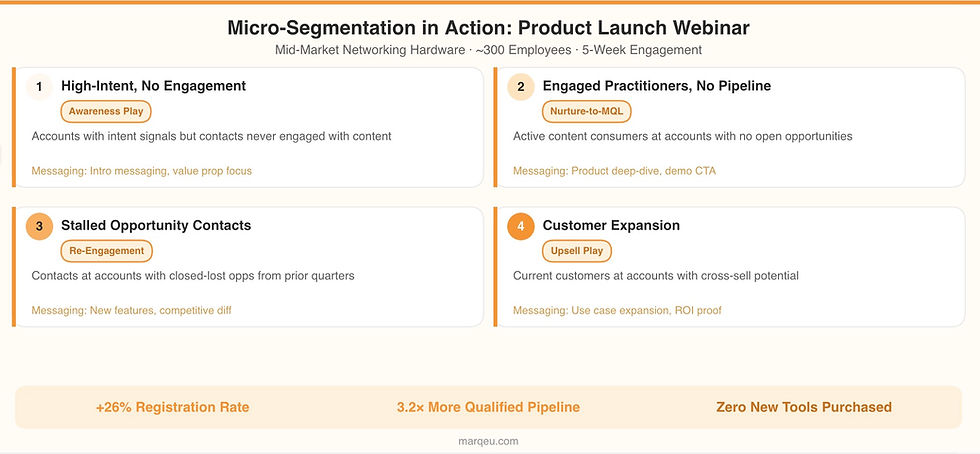
The first campaign the team ran on the new architecture was a product launch webinar. Instead of one broad segment, they built 4 micro-segments:
prospects at high-intent accounts who had never engaged before (awareness play)
engaged practitioners at accounts with no pipeline (nurture-to-MQL play)
contacts at accounts with stalled opportunities (re-engagement play)
existing customers at accounts with upsell potential (expansion play).
Each micro-segment received different messaging, different offers, and different follow-up sequences.
Webinar registration rates increased 26% versus their previous launch events. The campaign generated 3.2X more qualified pipeline than any comparable webinar in the previous four quarters. The marketing team did not buy a single new tool. They built a better architecture.
How to Build a B2B Segmentation Capability: The 6-Week Implementation Roadmap
Whether you are adding new segmentation software or building on your existing stack, the implementation sequence matters enormously. We have seen organizations waste months because they started with the wrong step. At marqeu, based on our experience of working with numerous B2B companies on marketing analytics consulting projects, we have refined this into a 6-week implementation methodology that moves fast without cutting corners with overlapping phases that keep the timeline compressed while maintaining quality.
Phase 1: Audit and Discovery (Week 1)
Before touching any technology, define the business questions:
What do your marketing and sales leaders need to know about prospects that they cannot know today?
What segmentation capabilities would change how campaigns are planned and executed?
Map every data source that exists, where it lives, and what its quality looks like. Assess pipeline completeness, identify integration requirements, and document the target segmentation dimensions. This phase prevents the most expensive mistake in MarTech: building something that does not serve the use cases that matter.

Phase 2: Data Foundation (Weeks 2–3)
Clean the data you have before connecting new sources. Standardize the key industry, job function, job level, company size, geography. Implement enrichment if your database completeness is below 60% on critical fields. Simultaneously, stand up Fivetran connectors and configure the initial data extraction pipelines into Snowflake or BigQuery. Author the first dbt staging models that normalize raw data from each source. This phase runs in parallel: cleanup and enrichment on the operational side, warehouse setup and connector configuration on the infrastructure side.
Phase 3: Segmentation Engine Build (Weeks 3–5)
Build the dbt transformation models that create the unified analytical layer: contact profiles joined with account data, engagement scoring computed across channels, intent signals merged from third-party providers. Build the visual segmentation interface on top of the transformed data this is where Tableau, Looker, PowerBI, or Sigma sits on the warehouse and gives marketing analysts the ability to construct multi-dimensional segments on the fly. Include the 4 core segmentation dimensions:
firmo-graphic data
campaign engagement history
pipeline and account context
intent and web engagement signals
Phase 4: Activation and Optimization (Weeks 5–6)
Close the loop by implementing reverse ETL (Census, Hightouch, or platform-native APIs) to push warehouse-built segments back into Marketo, HubSpot, or Salesforce for campaign execution. Configure automated daily syncs. Run the first campaigns on the new architecture, measure results against historical benchmarks, and optimize segment definitions based on initial performance data. Hand off system documentation and train the marketing team on self-service segment building.
For organizations with an established data warehouse already in place, this roadmap can compress further to 4 weeks. For organizations building from a completely greenfield state with significant data quality issues, plan for up to 6 weeks to a fully operational segmentation engine.
Why Consulting Implementation Outperforms DIY for Segmentation Architecture
Building a segmentation engine is not a plug-and-play exercise. It requires expertise across 3 distinct disciplines:
data engineering (connecting systems, building extraction and transformation pipelines, managing data quality)
marketing analytics (designing the right dimensions, building the queries, creating the interfaces) campaign strategy (knowing what segments actually move pipeline based on years of B2B campaign experience)
Most B2B marketing teams in the 10 to 500 employee range do not have dedicated marketing analytics staff. The demand generation manager is running campaigns, managing the marketing automation platform, and reporting on results. There is no bandwidth to also architect a data warehouse integration, build segmentation dashboards, and implement reverse ETL.
This is exactly the gap that specialized consulting fills. At marqeu, we bring 15+ years of combined expertise across all 3 disciplines data engineering, marketing analytics, and campaign strategy honed across engagements ranging from 20-person startups to publicly traded enterprise technology companies. We implement the complete segmentation architecture typically delivered in 4 to 6 weeks. The client’s marketing team learns the system, takes ownership, and runs it going forward. We build the engine; they drive it.
Frequently Asked Questions
What is the best B2B segmentation software for companies under 500 employees?
For most B2B companies under 500 employees, the best segmentation investment is not a single tool but an architecture that connects the tools you already have. A data warehouse like Snowflake or BigQuery, integration tools like Fivetran, transformation logic in dbt, and a BI layer like Looker or Tableau will typically deliver more segmentation value than any standalone platform.
How much does B2B segmentation software cost?
Costs vary dramatically by category. Native marketing automation features are included in your existing Marketo or HubSpot subscription. Data enrichment runs $20,000 to $50,000 annually. CDPs range from $30,000 to $100,000 or more. ABM platforms start at $50,000 and can exceed $150,000 for enterprise. A data warehouse segmentation architecture typically costs $15,000 to $30,000 in annual tooling plus consulting implementation.
Can I build advanced segmentation without buying new software?
Yes. If your marketing automation platform and CRM already contain the core data you need, building a segmentation engine on a cloud data warehouse can unlock multi-dimensional segmentation using your existing data. This is the approach we implement most frequently through our consulting practice.
What is the difference between a smart list and a segmentation engine?
A smart list filters contacts based on data inside a single platform. A segmentation engine queries data from multiple systems simultaneously your CRM, marketing automation, web analytics, intent data, and more through a unified data warehouse to build audience segments from the complete picture of each prospect.
How long does it take to implement a B2B segmentation architecture?
Timeline varies based on existing infrastructure. Organizations with an established data warehouse can expect 4 weeks. Organizations building from a greenfield state typically run 6 weeks to a fully operational segmentation engine with automated segment activation back into their campaign platforms.
Ready to Build Your Segmentation Architecture?
If your team is still building one-dimensional campaign segments based on job title and industry, the potential sitting untapped in your existing data is significant. You do not necessarily need new software. You need the right architecture and the implementation expertise to make your existing stack deliver multi-dimensional segmentation.
At marqeu, we specialize in exactly this: building that transforms how B2B organizations segment, target, and convert their database. With over 15 years of experience implementing custom marketing analytics solutions for B2B marketing organizations from early-stage startups to the largest enterprises, our engagements are fixed-fee, implementation-focused, and designed to hand you a working segmentation engine in 4 to 6 weeks that your team can operate independently.
Let us evaluate your current stack and give you a roadmap to advanced segmentation capabilities.

We’ve deployed this methodology across numerous B2B organizations and know where the implementation traps are before you hit them. The first conversation is about understanding your current state your tech stack, your data maturity, and where the gaps are. From there, we build the roadmap.
Book a Marketing Analytics Readiness Audit. With our marketing analytics consulting services, let us evaluate your current stack and give you a roadmap to building unified marketing analytics capabilities at your organization.


Comments