
Account Based Marketing (ABM) KPIs and Dashboards: 6 Metrics That Drive Pipeline ROI


Account Based Marketing (ABM) KPIs and Dashboards: 6 Metrics That Drive Pipeline ROI
Picture the quarterly business review. The VP of Marketing has spent 3 weeks pulling together the ABM results deck. The slides look sharp:
a heat map of target account engagement
a breakdown of campaign impressions by vertical
a timeline of content interactions across the top 50 accounts
The CFO looks at the last slide, leans forward, and asks a single question: how much pipeline did we actually generate from these accounts?
The room goes quiet. Not because the team did not work hard. Not because the program was not running. But because none of the metrics on those slides can answer that question. The engagement data is real, the campaign data is accurate, and none of it connects to a dollar amount in Salesforce.
This is the ABM measurement failure pattern we see most frequently at marqeu during our ABM analytics implementation projects. The program exists. The tools are running. The dashboards are filled with activity data. But the underlying ABM KPIs were never designed to connect account engagement to pipeline and revenue outcomes. So, when leadership asks the only question that determines budget next year, there is no credible answer.
This guide covers the six ABM KPI categories that actually measure account-based performance, how to design dashboards for three distinct audiences, how platforms like Demandbase and 6sense fit into the measurement stack, and what good ABM performance actually looks like in the numbers. If you are looking for the infrastructure layer that makes these KPIs possible, the ABM analytics guide covers the data foundation, measurement framework, and stack build in detail. This guide goes tactical.
Why Standard Marketing Metrics Fail Account-Based Programs

The measurement problem in ABM is a unit-of-analysis problem. Traditional marketing analytics is built around the individual lead. Everything in the standard demand generation stack: MQL volume, cost per lead, email open rate, form conversion rate, campaign click-through rate traces what individual people did in response to individual campaigns. These metrics work for demand gen because the lead is the thing you are trying to generate.
ABM inverts that model completely. You are not trying to generate leads from a target company. You are trying to build sustained, multi-threaded engagement across a buying group at a specific account, and eventually convert that account-level engagement into a qualified sales conversation. A contact downloading a white paper is interesting. Four contacts from the same Tier 1 account consuming ROI-related content in the same two-week window, while the account's G2 review research activity spikes, is a buying signal. The individual lead metrics cannot see that pattern. They can only see four separate lead events.
The problem compounds at the executive level. ABM operates on a quarterly cycle. A Tier 1 account with a nine-month buying process will not produce meaningful pipeline data in six weeks. If the program's reporting is built on weekly demand gen cadences and lead-level metrics, the program looks like it is not working for months before the results become visible. In our experience across numerous B2B organizations, the ABM programs that lose internal support before they produce results almost always had a measurement framework borrowed from demand generation rather than designed for account-based motion.
The Six ABM KPI Categories
Every ABM program, regardless of the tools in the stack or the size of the target account list, needs reporting capability across 6 measurement categories. Each category answers a different question about the health of the program. Together, they give revenue leadership the account-level intelligence that demand generation metrics cannot produce.
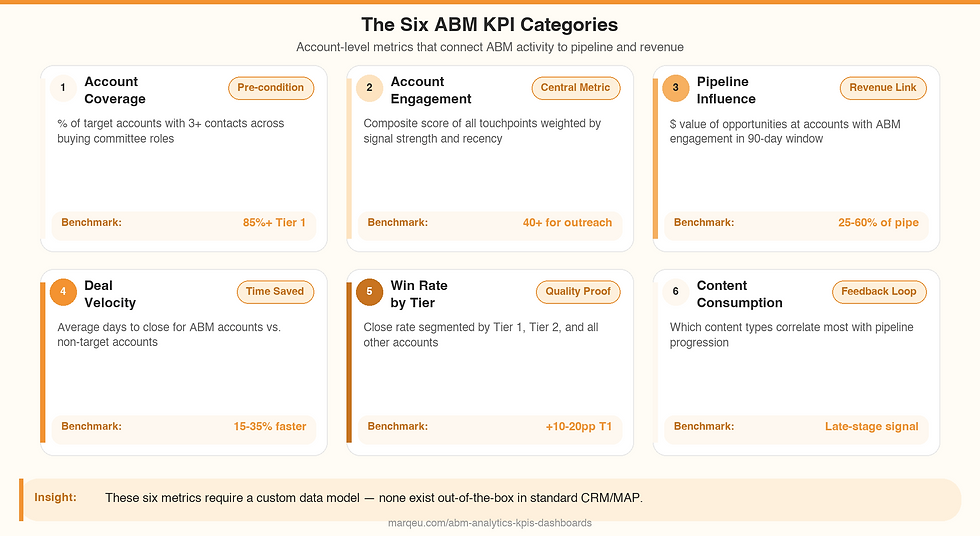
KPI 1: Account Coverage
Account coverage measures how many contacts at each target account are known to marketing and sales, and how well those contacts represent the full buying committee. It is the pre-condition metric the one that determines whether every other KPI has any hope of being accurate.

What it measures: The percentage of target accounts that have a minimum viable contact set mapped across buying committee roles. For most B2B technology sales motions, a minimum viable contact set means at least three contacts per account distributed across economic buyer, technical evaluator, and end-user champion roles.
Formula: (accounts with three or more mapped contacts across ICP buying roles / total accounts on target account list) × 100.
What good looks like: Tier 1 accounts should reach 85% coverage or higher before any meaningful ABM campaign spend is deployed against them. Tier 2 accounts should be at 65 to 70%. Any account below 50% coverage is not ready for ABM engagement it is a data problem that requires prospecting and enrichment work before campaign investment makes sense.
What to do when it is low: Coverage gaps at Tier 1 accounts are the highest-priority remediation in any ABM program. The immediate levers are data enrichment through vendors like ZoomInfo or Cognism, targeted prospecting by the SDR team, and review of the lead-to-account matching configuration in Salesforce to ensure that existing contacts are properly associated.

A cybersecurity SaaS company we worked with was struggling with an ABM program that had been running for seven months with minimal pipeline impact. When we audited their target account list coverage, we found that 44 percent of their 120 Tier 1 accounts had fewer than two mapped contacts, and those contacts were almost entirely individual contributors rather than decision-makers. Seventeen of the top 30 accounts on the list had exactly one contact in Salesforce. The ABM campaigns were technically running, but they were reaching a single person at companies that required six to eight stakeholders to sign an enterprise deal. After a six-week prospecting and enrichment sprint that brought Tier 1 coverage above 80 percent, the same campaign programs produced three times the account engagement they had generated in the prior quarter.
KPI 2: Account Engagement Score
Account engagement score is the central operating metric for ABM programs. It is a composite number, calculated at the account level, that aggregates all marketing and sales touchpoints and weights them based on their predictive value for pipeline readiness.
What it measures: The cumulative depth of interaction between a target account and your company across all channels content consumption, website visits, email engagement, event attendance, SDR conversations, and intent surge signals weighted and decayed over time to reflect current momentum rather than historical activity.
The weighting hierarchy that matters: Not all engagement is equal. A request for a pricing conversation or a custom demo carries far more predictive weight than a single white paper download. A live event attendance and a live product demo are materially more meaningful than an on-demand content view. The weighting model should reflect your actual closed-won data: what sequence of engagement activities appeared most consistently in accounts that converted to pipeline? If you have not modeled this yet, a reasonable starting framework weights demo requests at 25 to 30 points, pricing page visits at 15 to 20, live event attendance at 10 to 15, content downloads at 3 to 5, and email clicks at 1 to 2 on a 100-point scale.
Score decay matters as much as score accumulation. An account that scored 65 points six months ago but has had no activity in 90 days is not a 65. Time-based decay ensures the engagement score reflects current momentum, not historical interaction. Most configurations apply a 10 to 15 percent weekly decay rate to ensure that recency is built into the score model.

What good looks like: Tier 1 accounts should average an engagement score above 40 before an outbound sales sequence begins. Accounts scoring 60 or above typically indicate active evaluation and should be in active sales motion. Accounts below 20 need marketing program attention before SDR investment is productive.
Tool configuration: In Marketo, account engagement scores aggregate through smart lists that pull contact-level behaviors up to the account record, then sync to a custom field in Salesforce. In HubSpot, the company object handles similar aggregation through workflow automation, though the native scoring granularity requires more custom configuration to achieve the same fidelity. Demandbase natively calculates account engagement scores and surfaces them in the platform useful for teams that do not want to build custom scoring logic in their MAP and CRM.
KPI 3: Pipeline Influence
Pipeline influence is the ABM metric that earns program budget. It measures whether ABM marketing engagement was present at the accounts where pipeline was created or advanced, and it translates account-level marketing activity into a dollar figure that finance and board-level stakeholders can evaluate.
What it measures: The total value of open and closed-won opportunities at accounts where ABM engagement activity was documented within a defined lookback window typically 30 to 90 days preceding or concurrent with the opportunity. It is a looser metric than full revenue attribution, which makes it more practical and more defensible in the early stages of a program.
Formula: Sum of opportunity ARR at target accounts where account engagement activity occurred within the lookback window / total ARR in pipeline for the period.

The 90-day lookback is a deliberate choice. Sixty days is often too tight for B2B sales cycles with complex buying committees. 180 days is too loose almost any target account will have had some marketing touchpoint within six months, making the influenced pipeline number artificially large and unconvincing to finance. Ninety days is the standard we use at marqeu for organizations with average sales cycles of four to nine months.
What good looks like: ABM programs in their first 12 months typically influence 25 to 35 percent of total pipeline. Mature programs running for two or more years with well-configured account engagement scoring and Tier 1 coverage above 85 percent typically influence 45 to 60 percent. Any program claiming to influence more than 75 percent of pipeline should be audited for look-back window methodology the number is usually a calculation problem, not a performance breakthrough.
Implementation requirement: Pipeline influence reporting requires a direct data join between your ABM-tagged target account list and your Salesforce opportunity records. The report logic filters active opportunities where the associated account has an engagement activity date within the lookback window. This is buildable natively in Salesforce reporting with custom report types, and exportable into any BI layer for executive dashboard presentation.
KPI 4: Deal Velocity
Deal velocity measures how quickly target accounts move from first meaningful engagement to closed-won revenue, and compares that timeline to non-ABM accounts in the same period. It is the clearest evidence that ABM is doing what it promises: accelerating sales cycles at high-value accounts.

What it measures: Average number of days from first recorded engagement event at the account level to closed-won opportunity, for target accounts versus all other accounts in the same time period and deal size cohort.
Why this comparison matters: The velocity number in isolation does not mean much. A 180-day sales cycle could be excellent or terrible depending on the deal complexity, industry, and product. The meaningful data point is the differential: if Tier 1 ABM accounts are closing 30 percent faster than comparable non-target accounts, that is a measurable business impact. It means the sales team is spending fewer resources on elongated deal cycles at high-priority accounts, and it means ABM engagement is genuinely warming accounts before sales enters the picture.
What good looks like: After 12 months of consistent ABM program execution, Tier 1 accounts typically show 15 to 35 percent faster average deal velocity compared to non-target accounts at similar deal sizes. Programs seeing less than 15 percent velocity improvement should examine whether Tier 1 account engagement is actually triggering timely SDR follow-up the velocity gains depend on sales acting on the engagement signals at the right moment.
Tool configuration: Salesforce opportunity age reports segmented by ABM tier field provide the raw data. The report requires a custom field for first account-level engagement date (not first lead creation date, which often predates active ABM engagement significantly) and a tier designation field that holds the account's ABM tier at the time the opportunity was created. Without those two fields configured correctly, the comparison is not meaningful.
KPI 5: Win Rate by Tier
Win rate by tier measures the close rate for Tier 1 accounts versus Tier 2 accounts versus all non-ABM accounts in the same period, and it serves as the audit mechanism for your account tiering model. If ABM is working and the tiering decisions are correct, Tier 1 accounts should win at a measurably higher rate than Tier 2, which should win at a higher rate than non-target accounts.
What it measures: Closed-won opportunities divided by total opportunities created in the period, segmented by ABM tier designation at the time of opportunity creation.

What good looks like: Mature ABM programs targeting well-qualified Tier 1 accounts typically show win rates 10 to 20 percentage points higher than the company baseline for all accounts. If Tier 1 win rates are at or below the company average after 12 months, one of two problems exists: the tiering criteria are not actually identifying the accounts most likely to buy, or the ABM program is not delivering meaningful engagement depth at the Tier 1 accounts despite the designation.
The tier comparison is as important as the absolute number. A program where Tier 1 wins at 38 percent, Tier 2 wins at 28 percent, and the company baseline is 22 percent is working exactly as intended the tiers are predictive of outcome. A program where all three numbers are the same is a tiering problem, not a campaign problem.
Why this matters for budget conversations: Win rate by tier is the metric that proves account selection quality. When a CMO can show a board that accounts specifically identified by the ABM program close at significantly higher rates, the program earns the credibility that MQL volume never can.
KPI 6: Content Consumption by Buying Stage
Content consumption by buying stage maps which content types and topics correlate with pipeline progression versus stalled accounts at the same engagement level. It is the feedback loop metric: the one that tells your content and campaign team what to build next, based on evidence of what is actually moving accounts forward rather than assumptions about what buyers want to read.
What it measures: The distribution of content types and topics consumed by accounts that progressed from engaged to open pipeline in the period, compared to accounts with similar engagement scores that did not progress to pipeline.

Why the comparison is essential: Every ABM program will show that accounts consuming more content tend to generate more pipeline that is a correlation of engagement quantity, not quality. The useful signal is which specific content types appear disproportionately in the journey of accounts that progressed. If accounts that viewed your competitive comparison pages and ROI calculators converted to pipeline at twice the rate of accounts that downloaded top-of-funnel thought leadership content, that is an actionable content investment signal.
What good looks like: High-performing ABM programs typically see a clear pattern where late-stage content competitive alternatives, ROI and payback period materials, implementation case studies, and reference customer stories appears consistently in the engagement record of accounts that converted to pipeline within 60 days. If this pattern is not visible, one of two things is true: the content mix lacks late-stage assets, or the engagement score model is not weighting late-stage content interactions appropriately.
Tool configuration: Marketo program performance reports filtered by target account engagement, cross-referenced with Salesforce opportunity stage at the time of content interaction, produce the raw data. The analysis requires associating each content interaction with the account's pipeline stage at that moment a configuration step that requires the L2A matching and engagement aggregation infrastructure to be in place first.
ABM Dashboard Architecture: Designing for 3 Audiences
The most common ABM dashboard failure is treating all reporting consumers as the same audience. A CMO preparing for a board presentation needs completely different data from an SDR preparing their daily prospecting queue, and both need something different from the marketing operations analyst optimizing campaign allocation. Building one dashboard and expecting all three audiences to use it produces a tool that serves none of them well.
The Executive and CMO Dashboard (monthly and quarterly cadence)

The CMO dashboard answers three questions at a glance: how many high-priority accounts are actively engaged, how much pipeline has the ABM program influenced, and is the program improving deal quality compared to non-ABM accounts? It is built for five-minute consumption before a leadership meeting, not for deep analysis.
The components that belong on this dashboard: total TAL coverage percentage for Tier 1 accounts (with a red/yellow/green threshold indicator), influenced pipeline total and percentage of overall pipeline, deal velocity comparison showing ABM accounts versus the company baseline, win rate by tier displayed as a simple comparative table, and a single trend chart showing engagement score distribution across the Tier 1 TAL quarter over quarter.
What does not belong here: individual account details, campaign performance by program, content download volumes, or channel-level engagement breakdowns. Those are operational metrics. The executive dashboard should contain nothing that requires explanation when someone asks what they are looking at.
The Marketing Operations Dashboard (weekly cadence)

The marketing ops dashboard is the operational control panel for the ABM program. It answers: which accounts need attention right now, which programs are moving account engagement scores, and where are we losing momentum in the TAL?
Key components:
account engagement score distribution across the full TAL (broken into hot, warm, cold, and dark segments)
accounts where engagement has increased more than 15 points week over week (the accounts where sales follow-up should accelerate)
accounts where engagement has dropped more than 15 points (accounts losing momentum that may need a program adjustment)
program performance filtered by ABM account engagement rather than total lead volume
intent surge flags for accounts showing above-threshold third-party intent activity
The marketing ops view is the one that drives the weekly ABM sync between marketing operations, campaign managers, and SDR leadership. Its purpose is prioritization and course-correction, not executive storytelling.
The Sales and SDR Account Intelligence View (daily use)
Sales and SDR teams do not want a dashboard. They want an account view inside Salesforce that shows them, in the context of their territory, which accounts to call today and what to say when they do. The sales-facing ABM view is not a standalone dashboard it is a set of ABM fields surfaced directly on the Salesforce Account object.

What belongs on the account record view: current engagement score with a week-over-week trend indicator (rising, flat, declining), recent activity feed showing the last five marketing and SDR interactions at the account level, intent surge status and the topics driving it, open opportunity stage if one exists, and ABM tier designation with tier-specific playbook link. In a well-configured Salesforce instance, a sales rep can open any target account and immediately see whether this is an account where engagement is accelerating and outreach is warranted, or one where engagement is flat and a different nurture approach is needed.
Organizations using Demandbase or 6sense can surface their platform's native account intelligence directly in Salesforce through standard integrations, adding predictive buying stage and external intent enrichment to the internal engagement data described above.
Where Demandbase and 6sense Fit in ABM Analytics
Both platforms are built specifically for account-based measurement, and both add genuine analytical capability that internal CRM and MAP configurations do not replicate well. Understanding what each provides and where they do not eliminate the need for internal ABM data infrastructure is essential for teams evaluating the investment.
Demandbase
brings account-level analytics natively into the measurement stack. Its core analytical capabilities include account journey visualization (showing the progression of account engagement across advertising, website, and CRM touchpoints in a unified timeline), pipeline impact reporting that connects Demandbase-tracked engagement to Salesforce opportunity data, and account-level advertising performance filtered by ABM tier. For teams that do not want to build custom engagement scoring in Marketo and Salesforce, Demandbase's native account engagement scoring is a credible substitute that integrates with Salesforce via standard connector. Its Sales Intelligence module surfaces account-level activity directly in Salesforce account records, making the sales-facing view described above significantly easier to configure.

6sense
leads with predictive buying stage modeling. Its Revenue AI layer ingests third-party intent data across a network of B2B publisher sites and uses that behavioral pattern to predict where each target account is in its buying journey awareness, consideration, decision before any first-party engagement signals exist. For ABM programs targeting accounts with long research cycles and limited inbound activity, this predictive layer identifies in-market accounts earlier than internal engagement data alone can. 6sense's native dashboards surface account pipeline health, buying stage distribution across the TAL, and keyword intent trends by account and topic cluster.
What neither platform replaces:
Both Demandbase and 6sense depend on the same data foundation that makes internal ABM analytics work lead-to-account matching in Salesforce, properly configured account records, and opportunity data tied to the account layer. An organization with 30 percent L2A matching coverage will get poor signal from either platform, because the internal account data the platforms join against is incomplete. The infrastructure work described in the ABM analytics guide is prerequisite to getting full value from either platform, not an alternative to buying them.
When to invest in these platforms:
Demandbase and 6sense make the most sense for organizations with Tier 1 target account lists above 150 accounts, SDR teams of four or more people who need prioritized account queues, and the data foundation infrastructure already in place. The annual investment ranges from $30,000 to $150,000 depending on license tier and contract scope. Organizations still resolving L2A matching gaps and configuring their engagement scoring model should finish that work first. The platforms amplify good ABM analytics infrastructure they cannot substitute for it.
ABM KPI Benchmarks: What Good Performance Actually Looks Like
Benchmarks in ABM are tricky because program maturity, deal complexity, TAL size, and sales cycle length all affect what is achievable. These are directional reference points based on our work across 85+ B2B technology companies, weighted toward organizations with 50 to 300 Tier 1 accounts and average deal sizes between $40,000 and $500,000 ARR.

Account coverage: Tier 1 accounts should reach 85 percent minimum coverage before campaign investment begins. Below 60 percent coverage at Tier 1 is a data problem before it is a marketing problem. Programs that launch ABM campaigns against Tier 1 accounts below 70 percent coverage consistently underperform their counterparts who invest in the coverage work first.
Account engagement score thresholds: Accounts above 40 are actively engaged and warrant priority SDR outreach. Accounts in the 20 to 40 range are in active marketing nurture and should be receiving program engagement but not heavy SDR investment. Accounts below 20 are dark they need either prospecting to improve coverage or a program designed to generate initial engagement before any outreach attempt. Accounts above 60 are in active evaluation; the SDR team should be in direct contact, and marketing should be running tight account-specific content and event programs.
Pipeline influence: Early programs (first 12 months) should target 25 to 30 percent of total pipeline influenced by ABM activity. Programs in years two and three should be at 40 to 60 percent. If influenced pipeline is below 15 percent after 12 months, the measurement configuration is likely the problem specifically whether the Salesforce opportunity records are properly linked to the account engagement data.
Deal velocity: A meaningful velocity improvement from ABM is 15 to 35 percent faster deal cycles for Tier 1 accounts versus non-target accounts at comparable deal sizes. Programs seeing velocity improvements below 15 percent typically have an SDR follow-up timing problem: the engagement signals exist but the outreach response time is too slow to capture the moment of highest buying intent.
Win rate: After 12 months of consistent program execution, Tier 1 win rates typically improve by 8 to 18 percentage points over the company baseline. If the Tier 1 win rate is not meaningfully higher than Tier 2 and non-target accounts, the tiering criteria need to be revisited against closed-won data.
Content consumption signal: The clearest sign that your content mix is right for ABM is when 55 to 65 percent of accounts that progressed to pipeline in the quarter consumed at least one piece of late-stage content competitive comparison, ROI framework, or implementation case study in the 60 days before the opportunity was created.
3 ABM Reporting Mistakes That Undermine Program Credibility
Even well-designed ABM programs lose leadership credibility when the reporting makes one of these mistakes. We see all 3 regularly in programs that have been running for six months or more.

Reporting campaign impressions instead of account engagement. Impressions, reach, and content views are activity metrics. They describe what the marketing team did. The question leadership is asking and the question that determines next year's ABM budget is what accounts did in response to that activity. A report that leads with "our ABM campaigns reached 8,400 contacts at 140 target accounts" and cannot follow with "and here is how that engagement translated to pipeline" will not survive its second quarterly review. Every ABM report should start with the account engagement score and pipeline influence metrics, and present campaign activity in that context.
Mixing lead-level and account-level data in the same view. The fastest way to confuse an executive audience is to present a dashboard that combines individual MQL data with account engagement data without clearly distinguishing the two. A chart that shows "442 MQLs generated from target accounts" next to "47% of Tier 1 accounts showed increasing engagement" is measuring two different things and implies a relationship between them that may not exist. Keep the lead-level demand gen reporting on its own dashboard. The ABM dashboard reports on accounts, not leads.
Averaging performance across tiers. A program where Tier 1 accounts are performing exceptionally well and Tier 3 accounts are underperforming will produce a mediocre average that makes the whole program look marginal. Reporting ABM performance as a single blended metric obscures the most valuable signal in the data that the tiering is working. Every ABM performance report should show Tier 1, Tier 2, and Tier 3 results separately, and should show each against the company-wide non-ABM baseline. The comparison across tiers is often the clearest argument for expanding the Tier 1 list and investing more in Tier 1 account engagement.
Frequently Asked Questions About ABM KPIs and Dashboards
What are the most important ABM KPIs?
The six ABM KPI categories that matter are account coverage, account engagement score, pipeline influence, deal velocity, win rate by tier, and content consumption by buying stage. These metrics measure account-level performance rather than individual lead activity and connect ABM marketing activity to pipeline and revenue outcomes. The most critical for budget justification are pipeline influence and win rate by tier.
How do I build an ABM dashboard in Salesforce?
Building an ABM dashboard in Salesforce starts with configuring custom account fields: tier designation, current engagement score, engagement score trend direction week over week, last marketing activity date at the account level, and intent surge status. From there, account-level reports filter opportunities by ABM tier, and dashboard components surface engagement distribution across the TAL and pipeline influence by account set. The configuration work typically takes three to five business days for a Salesforce administrator familiar with custom report types.
What is a good ABM engagement score threshold?
Accounts scoring above 40 on a 100-point scale are typically considered high-priority for immediate SDR outreach. Accounts in the 20 to 40 range are in active nurture. Accounts below 20 need prospecting and coverage work before campaign investment makes sense. Accounts above 60 are likely in an active evaluation and should be in direct sales motion. These thresholds should be calibrated against your closed-won data the engagement score levels that appeared consistently in the 60 days before opportunity creation are the thresholds that matter for your specific program.
How do I measure ROI from an ABM program?
The most practical entry point for ABM ROI measurement is influenced pipeline: the total value of open and closed-won opportunities at target accounts where ABM engagement occurred within a 90-day lookback window. This number is producible from standard Salesforce reporting and is auditable enough to present to finance and board audiences. More rigorous programs add deal velocity comparison and win rate by tier to show that ABM engagement is not just present at pipeline accounts it is measurably improving close rates and shortening sales cycles.
Building the ABM Reporting That Leadership Trusts
The organizations that build ABM reporting that earns annual budget consistently share one pattern: they designed the measurement framework before they needed the numbers. They defined what account engagement meant, configured their Salesforce account fields, and connected engagement data to opportunity records in the first 90 days of the program while the data was sparse and the reports were imperfect so that by the time leadership asked the pipeline question, there was a credible, auditable answer ready.
The ABM KPIs covered in this guide are not complicated to understand. The complexity is in the data infrastructure that makes them trustworthy: the lead-to-account matching configuration, the engagement score model built from closed-won patterns, the Salesforce custom fields updated consistently, and the BI layer that presents the right view to each stakeholder audience. That infrastructure does not appear on any campaign dashboard, and it does not generate MQLs or impressions. It is what determines whether your ABM analytics can answer the question that determines next year's budget.
If your ABM program's reporting cannot currently connect account engagement to pipeline influence, marqeu's ABM analytics consulting practice works with B2B technology companies to design and implement the full measurement stack from data foundation through executive dashboard within your existing CRM, marketing automation, and BI tools. We have built this infrastructure across numerous B2B companies. The problem is almost never the tools.
For the ABM execution model that needs to be in place before analytics can measure anything meaningful, the ABM execution framework guide covers account planning, data infrastructure, process automation, and reporting in detail.

For organizations building analytics infrastructure across demand generation, ABM, attribution, and database strategy, marqeu's B2B marketing analytics consulting practice covers the full scope from first data audit through board-ready reporting.
Book a Marketing Analytics Readiness Audit. With our marketing analytics consulting services, let us evaluate your current stack and give you a roadmap to building unified marketing analytics capabilities at your organization.


Comments