
How to Measure Marketing ROI Across Channels


How to Measure Marketing ROI Across Channels is our attempt to discuss the challenges modern revenue marketing organization faces and how we have been helping marketing leaders solve these challenges with our advanced marketing analytics frameworks and consulting services.
The CFO wants proof. The CEO wants numbers. Your board wants to know if marketing is actually driving revenue or just burning budget. And you’re sitting there with data scattered across Google Ads, LinkedIn, Salesforce, HubSpot, and a dozen other platforms, trying to piece together a coherent story about ROI. Sound familiar?
The reality is that measuring marketing ROI in B2B isn’t just difficult, it’s often impossible with traditional approaches.
Long sales cycles, multiple touchpoints, attribution complexity, and data silos conspire to make ROI measurement feel like reading tea leaves. At marqeu, we’ve helped over 65 organizations solve this exact problem through our consulting practice, and we’ve learned what actually works versus what sounds good in theory. This guide will walk you through a proven framework for measuring marketing ROI across multiple channels, complete with a free calculator you can use today. We’ll cover the mechanics of accurate ROI calculation, multi-channel attribution strategies, common pitfalls to avoid, and advanced techniques for incorporating customer lifetime value into your analysis. By the end, you’ll have a clear roadmap for proving marketing’s value to your executive team.
Why Traditional ROI Measurement Fails in B2B
The standard marketing ROI formula looks deceptively simple: (Revenue - Cost) / Cost × 100. Plug in your numbers, get your percentage, and you’re done. Except in B2B marketing, it’s never that simple.
The fundamental problem is that traditional ROI formulas were designed for simple, linear customer journeys. One ad, one purchase, easy attribution. But B2B buyers don’t work that way. They research for months, interact with your brand across multiple channels, involve 6-10 stakeholders in the decision, and take anywhere from 3-18 months to close. By the time they convert, they’ve touched your website 27 times, downloaded 3 white papers, attended 2 webinars, had 5 sales calls, and engaged with 14 different pieces of content.
Which channel gets credit for that deal? Which campaign drove the revenue? Traditional last-click attribution says the final touchpoint. First-click says the initial interaction. Both are wrong because they ignore 95% of the journey.
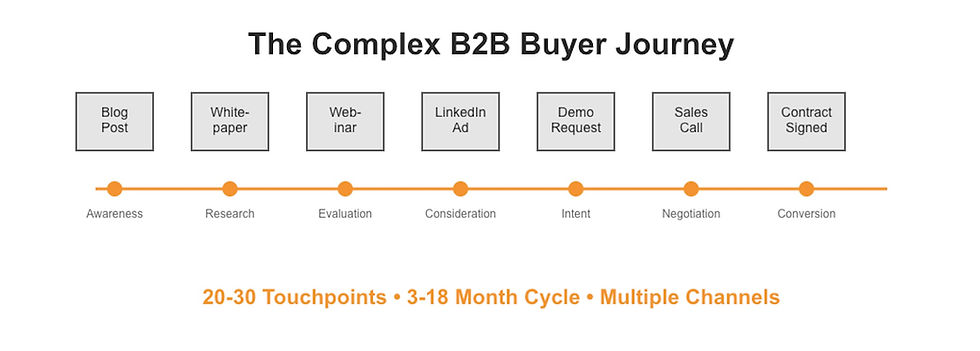
Then there’s the data fragmentation problem. Your Google Ads data lives in Google. LinkedIn metrics are in Campaign Manager. Email performance is in HubSpot or Marketo. Website analytics are in Google Analytics. CRM data is in Salesforce. Revenue attribution is... somewhere? Maybe in a spreadsheet someone manually updates monthly?
This data fragmentation makes it nearly impossible to calculate accurate multi-channel ROI without significant data engineering.
At marqeu, we worked with a large enterprise software company that was making marketing decisions based on completely false ROI data. Their VP of Marketing proudly showed us that paid search had a 12:1 ROI while content marketing barely broke even at 1.2:1. The decision seemed obvious: triple down on paid search, cut content investment.
The problem? Their measurement methodology gave 100% credit to the last touchpoint before conversion. When we implemented proper ROI tracking with multi-touch revenue attribution, the picture flipped completely. Content marketing actually drove a 7.8:1 ROI, while paid search was 2.3:1. Why? Because nearly every paid search conversion started with content consumption 3-6 months earlier. Content was the demand generation engine; paid search was just the final click.
This company had been on the verge of making a $3.2M budget reallocation that would have destroyed their pipeline. They didn’t have a strategy problem. They had a measurement problem.
Traditional ROI measurement also struggles with channel interaction effects.
Prospects who engage with both organic content and paid ads convert 340% more often than those who only see paid ads. But if you measure each channel in isolation, you miss this synergy completely. You might conclude that your blog has poor ROI because it rarely gets last-click attribution, when in reality it’s the foundation that makes every other channel work better.
The 3 Core Components of Accurate Marketing ROI
To measure marketing ROI accurately in B2B, you need
3 foundational components working together: unified data infrastructure, proper attribution modeling, and time-adjusted revenue recognition.
Component 1: Unified Data Infrastructure
You cannot calculate accurate multi-channel ROI with data scattered across platforms. This is not a nice-to-have but a mathematical requirement. Through our consulting work at marqeu, we’ve implemented unified marketing data architectures for 65+ organizations, and the pattern is always the same: companies that try to measure ROI without data consolidation get answers that are 40-70% off from reality. A unified data infrastructure means all your marketing touchpoints, spend data, and revenue outcomes flow into a single source of truth.

One mid-market healthcare technology company came to us with marketing data in 17 different systems. Their marketing team spent 15-20 hours every month manually pulling reports from each platform, copying data into spreadsheets, and attempting to reconcile discrepancies. ROI analysis was done quarterly because it took so long, and by the time they had numbers, the campaigns were already over. We consolidated everything into a cloud data warehouse with automated daily syncs. Their time to insights went from 3 months to real-time. More importantly, they discovered that their attributed revenue was being undercounted by $4.7M annually because their manual processes were missing cross-channel conversions.
Component 2: Proper Attribution Modeling
Once your data is unified, you need a methodology for distributing credit across touchpoints. This is attribution modeling, and it’s where most companies go wrong by either oversimplifying with last-click attribution or overcomplicated with custom algorithmic models that no one understands.
At marqeu, we recommend starting with position-based (U-shaped or W-shaped) attribution models before moving to custom algorithmic approaches.
Position-based models are interpretable, defensible to executives, and capture the reality that different touchpoints play different roles in the journey. A typical U-shaped model gives 40% credit to first touch, 40% to last touch, and 20% distributed across middle touches. W-shaped adds emphasis on the opportunity creation touchpoint.

One industrial manufacturing company we worked with had been using first-click attribution because their CEO believed in ‘demand generation.’ The result? Their content team got massive budgets while performance marketing was starved, because every deal traced back to an initial blog post or white paper download. With our marketing analytics implementation services, when we implemented a position-based model that properly credited the webinars and demo requests that actually moved deals forward, they realized performance marketing was driving 3.2x more pipeline value than credited. They rebalanced their budget and saw a 47% increase in qualified pipeline within two quarters.
Component 3: Time-Adjusted Revenue Recognition
The third component is matching revenue back to the marketing spend that influenced it, even when there’s a significant time lag. If you spend $100,000 on demand generation in January and close $500,000 in deals from those leads in June, your January marketing ROI should reflect that $500,000—not show zero because the revenue happened in a different period.
This requires tracking the full lifecycle of every lead from first touch through closed-won with the demand waterfall, then attributing the eventual revenue back to the original marketing touchpoints based on your attribution model. In practice, this means your ROI calculations need to be backwards-looking over a full sales cycle, not measured month-to-month in isolation.
At marqeu, we typically implement a ‘cohort-based ROI analysis’ approach where we track all marketing spend in a given period and then measure the revenue that flows from leads generated in that period over the subsequent 6-18 months. This gives you a true picture of ROI by accounting for the time lag between marketing activity and revenue realization. It also helps you understand how long it takes for marketing investments to pay off, which is critical for budget planning and forecasting.
Step-by-Step: Calculating Marketing ROI by Channel
With the three core components in place, you can now calculate accurate channel-specific ROI. Here’s the step-by-step process we use at marqeu for our consulting clients.

Step 1: Define Your Time Window and Attribution Look-back
Start by determining the appropriate time period for analysis. For most B2B companies, we recommend measuring ROI over a rolling 12-month period to capture a full sales cycle. However, the specific window should match your average deal cycle time. If your sales cycle is 4 months, a 6-month analysis window is sufficient. If it’s 18 months, you need at least 24 months of data.
Step 2: Calculate Total Spend by Channel
Sum up all costs associated with each marketing channel over your analysis period. This includes obvious costs like media spend, but also often-forgotten costs like agency fees, platform subscriptions, content creation, design work, and allocated headcount. Be comprehensive understating your costs inflates ROI and leads to bad decisions. A common mistake is only counting direct media spend while ignoring operational costs, which can underestimate true costs by 40-60%.
Step 3: Identify Revenue-Generating Conversions
Pull all closed-won deals from your time window. For each deal, you need the revenue amount, close date, and associated contact or account ID. This is where unified data infrastructure becomes critical. You need to connect CRM revenue data back to marketing touchpoint data, which requires proper identity resolution and account matching.
Step 4: Apply Attribution Model to Assign Revenue Credit
For each closed-won deal, look at all marketing touchpoints that occurred during your attribution look-back window. Apply your chosen attribution model to distribute revenue credit across those touchpoints. If you’re using a U-shaped model on a $100,000 deal with 10 touchpoints, you might assign $40,000 to the first touch, $40,000 to the last touch, and $2,000 to each of the 8 middle touches.
Step 5: Sum Attributed Revenue by Channel
Aggregate the attributed revenue across all deals to get total attributed revenue by channel. If organic search received $40,000 in attribution credit from Deal A, $15,000 from Deal B, and $28,000 from Deal C, the total attributed revenue for organic search is $83,000.
Step 6: Calculate ROI by Channel
Now you can calculate ROI for each channel using the formula: (Attributed Revenue - Channel Spend) / Channel Spend × 100.
If you spent $50,000 on organic search and it generated $83,000 in attributed revenue, your ROI is ($83,000 - $50,000) / $50,000 × 100 = 66%. For every dollar invested in organic search, you generated $1.66 in revenue, or a 1.66:1 return.
Real-World Example: A Mid-Market B2B SaaS Company
A mid-market B2B SaaS company came to marqeu after their CFO demanded proof that marketing was generating positive ROI. They had been operating on gut feel and last-click attribution, which showed paid search with an apparent 8:1 ROI and everything else underwater.

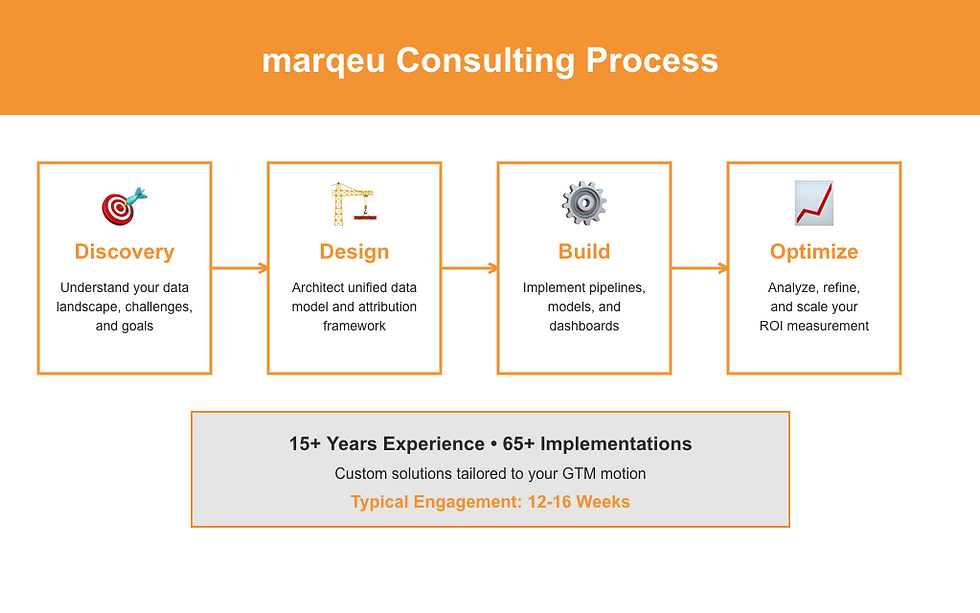
We implemented the six-step process above over a 16-week engagement. First, we consolidated their marketing data into a cloud data warehouse. Then we built a position-based revenue attribution model that credited first touch, opportunity creation, and closed-won touchpoints.
The results were eye-opening. Paid search was actually delivering 3.2:1 ROI, not 8:1. But content marketing, which had appeared to generate only 0.8:1 returns under last-click attribution, was actually their best-performing channel at 6.7:1 ROI. Webinars were at 5.4:1, email nurture at 4.9:1, and paid social at 2.1:1.

Multi-Channel Attribution for ROI Tracking
Multi-channel attribution is where ROI measurement gets sophisticated. It’s also where most companies make critical mistakes that undermine the entire analysis. Let’s break down what actually works.
The fundamental challenge is that B2B buyers interact with multiple marketing channels before converting, and these channels influence each other in complex ways. A prospect might discover you through organic search, download a white paper, attend a webinar, engage with a LinkedIn ad, visit your pricing page, and then convert on a demo request form. Which channel ‘caused’ the conversion? All of them played a role.

Attribution models are frameworks for distributing credit across these touchpoints. The model you choose has enormous impact on your ROI calculations and therefore your budget allocation decisions. Choose wrong, and you’ll systematically underinvest in high-performing channels while over investing in low-performers.
With our advanced marketing analytics consulting services, we work with our customers to understand their GTM strategy, sales and marketing execution model. We then work with them to suggest the most appropriate attribution methodologies, implement them and then train the teams to start leveraging the insights.
Case Study: A Marketing Technology Company
A mid-market marketing technology company approached marqeu with a classic attribution problem. They knew they were spending $4.2M annually on marketing, and they knew they were generating approximately $18M in new business, but they had no idea which channels were actually driving results.
Their existing setup used default last-click attribution, which showed that organic search and direct traffic drove 71% of revenue. But their CMO suspected this was wrong because they were investing heavily in content, events, and account-based marketing that weren’t getting credit.
We implemented a custom position-based attribution model through a 14-week engagement. The process involved consolidating data from their website, marketing automation platform, CRM, paid advertising, and event platforms into a cloud data warehouse. We built identity resolution logic that connected anonymous website sessions to known contacts, then attributed closed-won revenue back across all touchpoints.
The results completely changed their marketing strategy. Organic search was still important, but its attributed revenue dropped from $12.8M to $4.1M once we properly credited other channels. Meanwhile, content marketing went from $800K in attributed revenue to $5.9M. Events went from $1.2M to $4.7M. Account-based marketing campaigns that received zero attribution under last-click were actually driving $2.8M in revenue.

Most importantly, they discovered that cross-channel engagement was their highest predictor of conversion. Prospects who engaged with content, attended an event, and clicked a paid ad converted at 340% higher rates than those who only had one type of interaction. This insight led them to create integrated campaigns that deliberately used multiple channels together, which increased their overall marketing ROI from 3.3:1 to 7.1:1 over the following year.
Multi-channel attribution isn’t just about distributing credit fairly. It’s about understanding how your channels work together to drive revenue. When implemented properly, it reveals insights about channel synergies, optimal budget allocation, and the true customer journey that no single-touch model could ever show.
Common ROI Measurement Mistakes to Avoid
Through 10+ years implementing marketing analytics for B2B organizations, we’ve seen the same ROI measurement mistakes repeated over and over. Here are the ones that cause the most damage and how to avoid them.
Mistake 1: Ignoring Fully Loaded Costs
The most common mistake is calculating ROI based only on direct media spend while ignoring operational costs, platform fees, agency fees, and allocated headcount. This can inflate ROI by 2-3x and lead to massive over investment in channels that appear profitable but actually aren’t when fully costed.
For example, a company might report that their content marketing generates a 9:1 ROI because they’re only counting the $120,000 they spend on writers and designers. But they’re forgetting the $80,000 annual subscription to their content platform, the $60,000 they pay their agency for strategy, the $40,000 in promotion budget, and the $180,000 salary for the content manager who oversees everything. True content cost is $480,000, not $120,000. The real ROI is 2.25:1, not 9:1.
Mistake 2: Measuring ROI Too Frequently
B2B marketing operates on long cycles. Most companies have sales cycles of 3-12 months. Measuring ROI monthly or even quarterly doesn’t give enough time for campaigns to mature and generate results. This leads to premature optimization where you kill campaigns that actually work but haven’t had time to show results.
The fix is to match your measurement cadence to your sales cycle. If your cycle is 6 months, measure ROI over rolling 12-month windows. Use leading indicators (lead volume, engagement rates, pipeline velocity) for shorter-term optimization, but only evaluate true ROI over timeframes that allow marketing to generate revenue.
Mistake 3: Failing to Account for Attribution Windows
Many companies set their attribution look-back windows too short, which systematically undervalues channels with longer influence cycles. If you only look back 30 days for marketing touchpoints but your content marketing generates awareness that converts 90 days later, you’ll never properly credit content. At marqeu, we typically recommend attribution windows of 90 days for most B2B companies, with 180-3 days for enterprise sales with very long cycles.
Mistake 4: Treating All Revenue Equally
Not all revenue is created equal. A $50,000 deal that takes 3 months to close and has 95% retention is very different from a $50,000 deal that takes 12 months to close and has 40% churn. If you only measure initial ROI without considering customer lifetime value, contract value, or sales efficiency, you’ll optimize for the wrong outcomes. The solution is to calculate ROI based on projected customer lifetime value (CLV) rather than initial contract value. This requires understanding your retention rates, expansion patterns, and customer lifetime value by segment, then feeding those calculations back into your attribution model. It’s more complex, but it ensures you’re optimizing for long-term value creation rather than short-term revenue.
Mistake 5: Ignoring Sample Size and Statistical Significance
Small sample sizes create enormous variance in ROI calculations. If you only have 5 conversions from a channel in a given period, the ROI will swing wildly based on whether those deals happened to be large or small, fast or slow to close. Companies that make budget decisions based on small samples end up chasing noise rather than signal.
Factoring in Customer Lifetime Value (CLV)
Standard marketing ROI calculations measure return based on initial deal value. A campaign that costs $100,000 and generates $300,000 in new business shows a 2:1 ROI. Simple, clean, and completely misleading if different customer segments have dramatically different retention and expansion patterns.

Customer lifetime value (CLV) transforms ROI from a transactional metric into a long-term value metric.
Instead of measuring the revenue from the initial sale, you measure the total projected revenue a customer will generate over their entire relationship with your company. This matters enormously for companies with recurring revenue models, expansion opportunities, or significant variation in customer retention.
Consider two marketing channels. Channel A generates customers with $50,000 average contract value and 95% annual retention over 5+ years. Channel B generates customers with $80,000 average contract value but only 60% retention. Standard ROI says Channel B is better because it generates larger initial deals. CLV-based ROI reveals that Channel A customers are worth $225,000 over 5 years while Channel B customers are worth only $164,000. Optimizing for initial contract value would systematically underinvest in the channel generating better long-term customers.
Calculating CLV-Adjusted ROI
The basic CLV formula is: CLV = (Average Annual Revenue per Customer × Average Customer Lifespan) - Average Cost to Serve. For subscription businesses, a more precise version accounts for expansion, contraction, and time value of money:
CLV = ∑ (Projected Revenue Year N - Cost to Serve Year N) / (1 + Discount Rate)^N.
To calculate CLV-adjusted marketing ROI, you replace initial deal value with projected CLV in your attribution analysis. If a marketing campaign generated 20 customers with an average projected CLV of $300,000, the attributed revenue is $6,000,000 even if the initial contracts total only $2,000,000. Your ROI calculation becomes (Total Attributed CLV - Marketing Spend) / Marketing Spend. The technical implementation requires joining your attribution data with CLV models. At marqeu, with our advanced marketing analytics consulting services, we typically build cohort-based CLV models that calculate expected lifetime value based on customer segment, product tier, initial contract size, and acquisition channel. These models are updated quarterly as we observe actual retention and expansion patterns, then fed back into the ROI calculations.
One of the most important insights from CLV-based ROI analysis is that customer quality varies significantly by acquisition channel.
Customers from some channels consistently have higher retention, faster expansion, and lower churn than customers from other channels. This creates massive differences in true ROI that initial deal value completely misses.
CLV Implementation Considerations
CLV-based ROI is more complex to implement than standard ROI for several reasons.
First, it requires accurate CLV modeling, which needs historical retention, expansion, and churn data by customer cohort. Companies without at least 2-3 years of customer history struggle to build reliable CLV models.
Second, CLV is a projection, not a certainty. Your CLV model might estimate that a new customer will generate $400,000 over 5 years, but actual performance could be anywhere from $0 (if they churn immediately) to $800,000 (if they expand aggressively). This projection uncertainty makes CLV-based ROI harder to defend than revenue-based ROI, especially to finance teams who prefer actual dollars to projected dollars.
Third, CLV-based ROI creates a longer feedback loop. If you optimize marketing based on projected 5-year CLV, you won’t know if you made the right decision for 5 years. This can feel uncomfortable for marketers used to optimizing on short-term conversions.
At marqeu, we typically recommend a hybrid approach: use CLV-based ROI for strategic budget allocation across channels, but continue monitoring traditional ROI and leading indicators for tactical optimization. This gives you the long-term view needed for resource allocation while maintaining short-term feedback loops for execution. CLV-based ROI isn’t for every company. It requires data maturity, modeling capability, and organizational buy-in to optimize for longer-term value. But for companies with recurring revenue, significant customer lifetime value variation, or retention challenges, it’s the difference between optimizing for transactions and optimizing for enterprise value.
Frequently Asked Questions
How do you calculate marketing ROI?
Marketing ROI = (Revenue Attributed to Marketing - Marketing Spend) / Marketing Spend × 100. The critical detail is ‘Revenue Attributed to Marketing’ which requires an attribution model to distribute credit across touchpoints. For accurate measurement, track ROI by channel over a full sales cycle timeframe (typically 6-12 months in B2B) and include all costs: media spend, platform fees, agency fees, creative production, and allocated headcount. Use multi-touch attribution rather than last-click to properly credit channels that generate awareness and nurture even if they don’t get final-click conversions.
What is a good marketing ROI for B2B?
B2B marketing ROI benchmarks vary significantly by industry, sales cycle length, and attribution methodology, but general guidelines are: 2:1 is the minimum acceptable ROI (generating $2 in revenue for every $1 spent), 5:1 is average performance for well-optimized programs, and 10:1 is excellent performance typically seen only with highly efficient channels like organic search or mature content marketing programs. However, these numbers should be adjusted for customer lifetime value, a 3:1 ROI on customers with high retention and expansion might be better than 8:1 ROI on customers who churn quickly. Also note that different channels naturally have different ROI profiles: brand awareness campaigns might show 1-2:1 in the short term but drive long-term pipeline, while performance marketing might deliver 5-8:1 but require constant optimization.
Why is measuring marketing ROI difficult?
Measuring marketing ROI is difficult in B2B for several interconnected reasons. Long sales cycles (often 3-18 months) mean there’s significant lag between marketing spend and revenue realization, making it hard to match costs to outcomes. Multiple touchpoints across the buyer journey (prospects might have 20-30 interactions before converting) create attribution complexity which channel ‘caused’ the conversion? Data silos fragment information across platforms like Google Ads, LinkedIn, your CRM, your marketing automation platform, and your website, making unified measurement nearly impossible without data engineering. Lack of standardized tracking means touchpoints go unmeasured or are inconsistently categorized. Finally, there’s the fundamental challenge of proving causation rather than correlation—did your marketing cause the deal or did the prospect find you anyway? At marqeu, we solve these challenges through unified data infrastructure, proper multi-touch attribution, and time-adjusted revenue recognition that matches marketing spend to eventual outcomes even across long timeframes.
Ready to Measure Marketing ROI Accurately?
Accurate ROI measurement isn’t optional in modern B2B marketing.
Your CFO expects data-driven justification for marketing spend. Your CEO wants proof that marketing drives revenue. Your board wants to know if they should invest more in growth or optimize for efficiency. You can’t answer these questions with gut feel or last-click attribution.
Marketing should be the most measurable part of your business. Let’s make it so.
If you’re ready to move beyond surface-level ROI numbers and build a measurement system that actually reflects reality, marqeu can help. We’ve spent 10+ years implementing marketing analytics and attribution for B2B organizations, and we know what works. At marqeu, we believe marketing should dictate how technology facilitates measurement, not the other way around. Our advanced analytics consulting services build custom solutions tailored to your go-to-market motion, sales cycle, and business model rather than forcing you to conform to pre-built frameworks. We partner with your team to design and implement full-stack marketing analytics solutions from data warehousing and ETL infrastructure to custom attribution models and predictive analytics that give you transparent, defensible insights proving marketing's true impact.
Whether you're facing pressure to defend your budget, scale high-performing programs, or align more closely with sales, unified marketing data architecture gives you the answers you need. Start by acknowledging the problem. Recognize data silos as architectural deficiencies rather than inevitable complexity. If you’ve made it this far, you probably believe, like we do in the value of unified marketing analytics capabilities. It’s a way to make marketing more confident. More credible. More strategic. At marqeu, with our marketing analytics consulting services, we’ve helped some of the most innovative B2B companies build unified marketing analytics capabilities to understand what drives revenue, optimize marketing investment, and demonstrate ROI with confidence.
And we’re just getting started.
Book a Marketing Analytics Readiness Audit
With our marketing analytics consulting services, let us evaluate your current stack and give you a roadmap to building unified marketing analytics capabilities at your organization.


Comments